
On this page
Email marketing for ecommerce helps people choose a product, complete a purchase, use what arrives and decide when to buy again. A good program also knows when to leave someone alone. The welcome message that made sense yesterday may be irrelevant after today's order; a useful product lesson may be premature while delivery is delayed.
Start with the customer job you can support reliably. If your store is new, make signup delivery and order messages dependable before building a large automation library. If you already have several senders, inspect what one customer actually receives before adding another flow.
This guide builds a complete program for Cedar & Kettle, a tea shop, then changes the plan for a furniture store. All stores, people, products, dates, prices and results in these worked examples are fictional. The operating choices are examples to adapt, not reported merchant performance or universal sending benchmarks.
Give every email a customer job
Cedar & Kettle's owner, Nora, wants more first purchases and repeat orders. Those goals become useful when attached to a question a customer might have: Which tea should I try? Can I finish my checkout? How should I brew this pouch? Is it time to order more?
Different messages answer different questions. An Autumn Sampler launch helps a curious shopper compare three teas. Checkout recovery helps someone return to an unfinished purchase. Brewing guidance helps a buyer enjoy the product. A replenishment reminder makes sense only when there is a reasonable basis for thinking that buyer needs more tea.
Three terms keep the program understandable:
Campaigns are scheduled sends, such as a launch sent to a chosen audience on Tuesday.
Flows are triggered sequences, such as a message considered after an identifiable checkout. A flow can contain waiting periods and eligibility checks.
Segments are audience rules. “Marketable contacts who declared a caffeine-free preference” can qualify for either a campaign or a flow.
Service and marketing describe a message's purpose, not its delivery method. An order confirmation communicates an existing order. A triggered offer for another product promotes a new purchase. Automation does not turn an offer into a service message, and buying once does not settle someone's marketing permission.
For US commercial email, the FTC's CAN-SPAM guidance explains why primary purpose matters. Requirements elsewhere can differ. Establish the rules applicable to your business and recipients rather than treating a US compliance checklist as an international permission policy.
Nora gives each proposed email a one-sentence brief: “For this eligible customer, help with this next decision, using this evidence, and send them here.” If she cannot complete that sentence, the message is not ready.
For the sampler, the decision is whether a mixed tea selection suits the recipient. Product contents, caffeine information and price provide the evidence; the product page completes the decision. For an existing order delayed in transit, the customer needs an accurate update and a way to get help. A sampler offer cannot do that job.
Choose one program owner even when several people write or send. Nora owns Cedar & Kettle's overall marketing experience. Ellis, the operations lead, owns order and delivery accuracy. Their first shared task is to make every active sender visible.
Make the senders and data dependable
A store can have a commerce platform, marketing tool, review app and forgotten recovery integration sending independently. Looking only at the main email dashboard misses part of the customer's inbox.
Nora and Ellis use this filled register to decide what stays active. Marketing rows require current permission, a contactable address and the shop's shared suppression checks. Service rows follow their own narrow purpose and order rules.
Email job and sending owner | Entry and qualifying recipient | Fresh check, destination and decision |
|---|---|---|
Order and shipping updates: commerce platform; Ellis | An actual order or shipping-state change for that order's contact | Confirm the order, status and accurate details. Link to order status or help. Keep one service owner. |
Promised brewing guide and later welcome: email tool; Nora | A recorded guide signup; later persuasion only for eligible prospects | Fulfill the guide promise through a permitted route. Recheck purchase state before prospect content. Guide or relevant tea page. Keep promise delivery; repair stale prospect exits. |
Checkout recovery: email tool; Nora | Identified, marketable contact with a usable unfinished checkout | Recheck purchase, checkout validity, stock and competing messages. Return to that checkout. Keep one tested path. |
Legacy checkout reminder: old recovery app; Nora | The same checkout event as the current recovery path | Disable entry and pending sends, then inspect both logs with a test checkout. Stop after verifying retirement. |
Product-use education: email tool; Nora, with Ellis checking order state | Relevant purchased tea with an honest basis for receipt or use | Hold experience-dependent content for delivery problems; exclude cancelled or refunded purchases. Complete brewing guidance. Test a useful lesson. |
Review request: review tool; Nora | An eligible order under that tool's actual rules | Check receipt/use readiness, prior request or review, and unresolved exceptions. Relevant review destination. Defer until checks are dependable. |
Dated campaigns: email tool; Nora | Current audience for the specific product or lesson | Recheck permission, product fit, exceptions and marketing pressure. Exact product, collection or guide. Test the October plan. |
Replenishment: email tool; Nora | Suitable consumable purchase with evidence supporting the interval | Exclude gifts, duplicate subscription needs and intervening orders. Exact refill. Defer until history supports a test. |
Retiring the old reminder takes more than deleting its email template. Nora first records which app receives the checkout event, then disables the old app's recovery entry and any waiting messages using its supported controls. She runs an identifiable test checkout and inspects both apps after the former send delay has passed. The old log must show no reminder sent; the new path must show only the intended candidate. If an old queued job remains, she pauses recovery until she can remove it safely. Only then is the duplicate sender retired.
Check the facts each path needs
Keep stable contact, customer, order and product identifiers. Record where and when marketing permission was obtained and what it covered. Preserve checkout identifiers, order status, cancellations, refunds, stock and whatever fulfillment or delivery information your integration actually provides.
Missing data needs a defined outcome. An absent order match can mean “unknown,” not “never purchased.” A shipment event can mean the parcel left the warehouse, not that the customer has used the product. If a flow depends on receipt but receives only shipment data, either use truthful pre-arrival content or leave the experience-dependent step inactive.
Store both an event's occurrence time and the time the sending tool received it when those fields are available. A timely purchase in the store can still arrive late in email software. Test that delay; do not infer synchronization from a connected-app badge.
Establish sending readiness
Ellis checks the sending-domain setup against the email provider's instructions, including SPF, DKIM and DMARC where required. Nora checks the recognizable sender name, monitored reply destination, accurate business details and working unsubscribe route. Suppressions must reach every marketing sender, including jobs already waiting.
For personal Gmail accounts, Google's sender guidance covers authentication and expected mail; its bulk-sender rules require one-click unsubscribe for marketing and subscribed messages as well as a visible unsubscribe link. A footer link alone does not establish the required headers. Google also advises against mixing promotions into receipts. Verify the requirements that apply to your sending pattern rather than assuming a template handles them.
Start with expected mail to a well-defined audience, avoid abrupt unexplained volume changes, and inspect delivery errors and complaint feedback. “Delivered” generally means the recipient's server accepted a message. It does not establish inbox placement.
Grow a list you can serve
Cedar & Kettle offers a useful brewing guide plus occasional product news. It does not promise a first-order discount. That simple choice should remain consistent from the signup form to the first email and the later welcome sequence.
Put the invitation where its value is clear. A brewing article can offer the guide; a relevant product page can explain what subscribers will learn; checkout can offer a distinct marketing choice without confusing it with order updates. Avoid making visitors close several competing forms to read one page. A clear benefit near a moment of interest is a better starting point than more interruptions.
A practical form could say: “Get our brewing guide and occasional tea news.” Ask for the email address and only the preferences you will use. An optional caffeine-free preference changes future recommendations. Requiring a birthday that nobody will act on adds work without improving this program.
Preserve the signup source, promise, version and time with the permission record. Nora needs to distinguish someone who requested a brewing guide from someone imported during a different promotion. Purchased lists cannot supply that genuine expectation of hearing from this shop.
The promise handoff has two jobs. First, provide access to the requested guide in the confirmation experience or permitted email route and test the link. Second, introduce the store where permission and context allow it. If guide delivery fails, repair that job specifically. Sending three sales emails does not fulfill a missing guide.
Compare acquisition quality after signup
These illustrative earlier cohorts were each observed for 30 days. They are separate from the October campaign scorecard later in this guide.
Capture source | Form submissions | Valid, confirmed marketable subscribers | First buyers within 30 days |
|---|---|---|---|
Brewing-guide form | 100 | 90 | 18, or 20% of the 90 subscribers |
Generic discount form | 180 | 120 | 12, or 10% of the 120 subscribers |
The discount form produced more submissions and more valid subscribers. The guide cohort produced more first buyers. Nora keeps the guide promise while examining whether the other source attracted different visitors, carried a different acquisition cost or led to low-margin orders.
This is not a controlled comparison of form design. Different traffic, offers and customer composition prevent a causal verdict. Track contribution, unsubscribes and later purchases before calling either source better overall. Use completed eligible subscriptions as one denominator and label it clearly; raw captures conceal invalid addresses and incomplete subscription steps.
Once the promise and measurement are sound, these newsletter signup examples can help you choose a presentation. Keep the underlying offer understandable without requiring a visitor to study fine print.
Build audiences from current facts
Useful segments describe a decision you can make. Begin with a few rules that staff can explain and test, then add detail when it changes the message.
Apply the marketing eligibility filter first: current permission for this use, no relevant suppression, and a technically contactable address. Then apply product fit and current circumstances. Buying history, permission and product interest answer different questions; none substitutes for the others.
Starter audience | Working rule | Useful next message |
|---|---|---|
Eligible prospects | No qualifying purchase in reliable linked history; permission remains valid | Product-selection help or a relevant introduction |
First-time buyers awaiting delivery | Exactly one qualifying purchase; receipt is not established | Accurate order information or truthful preparation |
First-time buyers after receipt | One qualifying purchase and a defensible basis for receipt/use | Relevant brewing help, then an appropriate next choice |
Repeat buyers | At least two qualifying purchases | Category news, a useful new assortment or a relevant refill |
Category-interest contacts | An explicit preference or sufficiently reliable relevant behavior | Advice and products consistent with that interest |
Lapsed buyers | Inactive until comparable purchase history supports a stated interval; then no qualifying purchase by that boundary | A bounded reason to return |
Marketable but disengaged contacts | The explicit 90-day response test below, with enough delivered messages to assess | One preference check, then reduced routine sending |
Define a qualifying purchase consistently, including how you treat cancelled and refunded orders. Keep “history unavailable” outside the prospect rule. Also separate waiting for delivery from ready for product-use advice, even if both groups made their first purchase yesterday.
The six contacts in this example make those distinctions practical:
Maya initially has no linked qualifying purchase, then starts checkout and buys. Her appropriate next message changes each time.
Leon has bought twice and declared a caffeine-free preference. He belongs in caffeine-free education, but the mixed Autumn Sampler contains caffeinated tea and is excluded.
Sam's recent purchase was a gift. That order does not tell Nora when Sam's own tea supply will run out.
Rae has an active subscription. A reminder to buy the tea already scheduled for shipment duplicates the subscription's job. A genuinely different assortment needs its own fit check.
Noor has a guest order that is not yet confidently linked. Nora withholds first-order-only persuasion while Ellis investigates the identity connection.
Iris opts out while marketing is queued. Nora cancels the pending marketing; legitimate updates about Iris's own order retain their separate purpose.
A customer can belong to several segments and still have an active checkout or delivery problem. Segments provide candidates, not an unconditional send instruction.
Customer lapse also differs from email disengagement. Someone may buy regularly without clicking campaigns, while an enthusiastic reader may not have purchased for months. Review purchase history and reliable response signals together. Apple's Mail Privacy Protection can load remote content privately in the background, so an image-load signal does not prove a person read the email. Avoid defining inactivity, or deciding who gets a resend, solely from opens.
Build the next flow for a reason
For established Cedar & Kettle, the immediate opportunity is to keep one reliable recovery path and make the welcome sequence respond correctly to purchases. Adding another branch before fixing those exits would increase the chance of sending the wrong persuasion.
Build in dependency order: dependable service and permission handling; promise delivery and welcome; identifiable recovery where meaningful volume exists; then education and repeat-purchase needs supported by order data. The number of available flow templates is not a target.
Welcome and recovery
A subscriber is new to the list, not necessarily new to the store. The first welcome job is Cedar & Kettle's promised brewing guide. Subsequent prospect content can help someone choose between tea styles, but first-purchase language exits when a qualifying purchase becomes known. Existing customers can receive genuinely useful guide content without being told to place their first order.
Keep the initial sequence small enough to inspect. Nora begins with the guide and one later product-selection message, then examines questions and buying behavior before adding another step. The welcome email guide provides more complete copy and sequence examples when this specific path needs expansion.
Recovery requires a known, eligible recipient and a usable destination. An anonymous page visit is insufficient for an email. A known product view is a weaker signal than an identifiable checkout, so the stronger event replaces weaker competing recovery candidates. The store should not send browse, cart and checkout reminders as if each happened to a different person.
Choose an initial wait that gives shoppers room to finish, then test it against your purchase cycle. Cedar & Kettle's worked case schedules a recovery check for the morning after checkout. That is a hypothesis, not a best-time claim. Immediately before sending, check for a completed purchase, invalid or cancelled checkout, changed stock, changed permission and a higher-priority message.
Use the checkout identifier to prevent one repeated event from creating multiple entries. Re-entry should require a genuinely new eligible checkout and the shop's chosen cooldown, not merely another copy of yesterday's event. End the bounded attempt when it no longer serves the shopper; do not create an indefinite reminder sequence. Detailed timing and copy choices belong in the cart recovery guide.
After purchase
The commerce platform sends the receipt and accurate shipping updates. Marketing education, review requests and another offer each need a separate reason and readiness check. The order-confirmation guide explains the receipt's job in more detail.
For tea, a lesson about adjusting a bitter brew can be useful when the customer has the relevant product. Before arrival, the same message should not say “How did your first cup taste?” Cancelled or refunded orders leave purchase-dependent education and offers unless another valid purchase independently qualifies the person.
Review requests need time for a real experience, one responsible sender and checks for an existing request or review where the system supports them. A delivery problem calls for service first. Once it is resolved and the experience is possible, apply neutral eligibility rules rather than selecting only customers expected to be positive. See the review-request guide for that sequence's detailed construction.
Repeat purchases and disengagement
Replenishment concerns likely product depletion. Win-back concerns a customer whose next purchase is later than expected. Re-engagement concerns whether continued email is useful or wanted. Those are three different diagnoses.
Nora leaves lapse and refill audiences inactive while Ellis exports dated qualifying purchases, groups comparable tea buyers and calculates days between consecutive orders. Exclude gifts and subscription shipments. Keep buyers who have not returned in a separate, equally mature cohort; studying only repeat buyers would hide them.
For a calculation-only sample, intervals of 30, 40, 50, 60, 70 and 80 days have a median of 55 days; four of six repeat orders occur by day 60. Six returning buyers cannot establish a store-wide deadline. With a larger stable cohort, Nora could test a boundary after its usual return range, checking who has already bought again and whether service or stock explains the delay. Recheck by product and season. Without enough comparable history, keep the audience inactive, including the November 3 refill entry. Purchase timing alone does not prove depletion. A relevant refill can start at $20, using the exact available product and price.
Repeat buyers can also benefit from access to relevant new assortments or useful product knowledge without a discount.
In a store with a loyalty program, a shopper with an unused $5 reward could receive a reminder linking to the rewards page. Verify the benefit is currently redeemable, including minimum spend and expiry. Skip it if used, expired or unavailable; recheck permission, exceptions and competing sends. Keep the reminder separate from any claim that the shopper needs more product.
For a lapsed buyer, choose one bounded return invitation with a clear reason; exit on purchase, opt-out or the end of that attempt. For disengagement, Nora proposes a different test: marketable contacts subscribed for at least 90 days, with at least four delivered marketing messages during those 90 days, but no reliable human click, reply or qualifying purchase. Exclude known automated clicks and unresolved delivery problems; opens do not qualify. Where those signals are unavailable, leave this rule inactive. For this test, send one permitted preference check, wait 14 days, then suppress routine campaigns if there is still no response. A new explicit request or reliable response prompts an eligibility review before re-entry; a purchase alone does not renew marketing permission. These are starting test parameters, not universal cutoffs.
A new shop with little traffic should choose differently. It can establish a dependable signup guide, useful product pages and accurate order messages before spending days on replenishment predictions. Manually reviewing the first few customer questions may reveal a more valuable education email than an elaborate automated branch with almost nobody eligible.
Plan campaigns customers have reason to read
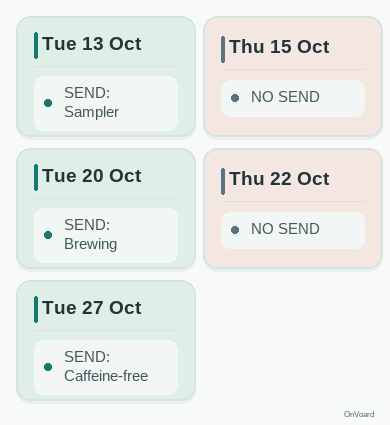
Flows respond to individual events. Campaigns give a selected audience a timely reason to explore something: a new assortment, practical guidance or a collection matching a declared preference. Having flows does not remove that editorial job.
Nora plans four weeks, October 12 through November 8, 2026, in the store's America/New_York time zone. The dates and cadence below are illustrative choices. Every campaign still faces a final person-level eligibility check.
Date and decision | Audience and customer-facing job | Destination, conflict and success check |
|---|---|---|
Tuesday, October 13: send Autumn Sampler launch | Eligible shoppers interested in trying several tea styles; exclude caffeine-free-only preferences | Sampler product page. Maya's active checkout takes priority. Review qualified clicks, orders and contribution, plus unsubscribes. |
Thursday, October 15: skip second launch reminder | No new product fact or offer gives the same audience another reason to read | No send. Inspect questions and product-page friction before deciding more email is needed. |
Tuesday, October 20: send brewing guidance | Eligible recipients whose relevant tea and current state fit a repeatedly asked brewing question | Complete brewing guide. Exclude those who just received the same lesson in a flow. Inspect guide visits and subsequent questions, with purchase effects secondary. |
Thursday, October 22: skip broad catalog promotion | The proposed all-list message lacks a specific customer job | No send. Preserve current service exceptions and the person-level pressure policy. |
Tuesday, October 27: send caffeine-free assortment introduction | Declared caffeine-free audience, including Leon, with no active conflict | Caffeine-free collection. Check product fit and availability; measure collection visits, qualifying orders and contribution. |
Tuesday, November 3: conditional refill test | Suitable non-gift, non-subscription buyers whose history supports a refill interval | Exact refill product. Send only to a justified test audience; otherwise no campaign. Review repeat orders within the chosen observation window. |
The fourth week deliberately has no guaranteed send. If Nora cannot establish a credible replenishment audience, she keeps the calendar empty and completes the analysis. Sam and Rae remain excluded from personal depletion assumptions. Dates organize preparation; they do not create customer need.
For October 20, the lesson must answer a question customers actually have. If bitterness is the recurring issue, publish a complete guide tied to the relevant tea's brewing instructions and offer one clear next adjustment. Do not stretch “educational” into a label for an unrelated promotion. For October 27, verify that the destination contains caffeine-free products rather than linking Leon to a broad tea collection that makes him filter again.
A complete Autumn Sampler launch email

Contiguous campaign excerpt. Full campaign context: desktop · mobile

Contiguous campaign excerpt. Full campaign context: desktop · mobile
This campaign helps suitable shoppers evaluate one product. There is no launch discount and no invented deadline. The copy makes the mixed caffeine content clear before the click.
Sender: Nora at Cedar & Kettle
Subject: Meet the Autumn Sampler: three teas, $36
Preview text: Three 40 g pouches, from caffeine-free rooibos to black and green tea.
Email body:
Hello,
Want to try a few different teas without choosing just one?
Our Autumn Sampler brings together three 40 g pouches for $36:
Toasted Apple Rooibos, 40 g
Smoky Breakfast Black, 40 g
Orchard Green, 40 g
Start with the one that catches your interest, then try the others when you want a change. The separate pouches let you choose which tea to brew each time.
One thing to know before you choose: Toasted Apple Rooibos is caffeine-free. Smoky Breakfast Black and Orchard Green contain caffeine. If you only drink caffeine-free tea, this mixed sampler won't be the right fit.
The sampler is $36, with shipping calculated at checkout. You can see the full selection and current availability on the product page.
Explore the Autumn Sampler
Happy brewing,
Nora Cedar & Kettle
Primary CTA destination: The intended live Autumn Sampler product page, showing these three pouches, the $36 price, current availability and shipping information.
When adapting the example, connect the CTA to your real product page and verify every product fact. Configure your normal verified business footer and unsubscribe controls separately; the fictional example does not supply a real postal address.
The sender is recognizable, the subject states the product and price, and the preview adds useful detail. A missing first name cannot break the greeting. The CTA continues the exact decision raised in the email. Compare that with a delayed-order message: its first screen should establish the order's current status and the available help, not introduce three teas.
Use readable live text for the offer, contents and caffeine note. Images can show the product, but essential facts should survive blocked images. Check contrast, mobile text size, descriptive alt text and a comfortably usable button. Keep the first screen focused on what the product is and why this recipient might want it. The email layout guide extends those design decisions.
Nora previews the actual email in mobile and dark mode, opens its links, and follows the buying path through the intended checkout. A polished email cannot rescue the wrong variant, unavailable product or contradictory price on the destination page.
Resolve the inbox one person at a time

Cedar & Kettle starts with a policy of at most one discretionary marketing send per person in a rolling 24-hour period. This is a provisional operating choice, not a universal recommendation or an assumed feature of any tool. A still-relevant checkout gets that slot ahead of generic welcome persuasion or a campaign.
Service and promised-benefit handling remain separately evaluated. The cap must not block an accurate order update or become an excuse to forget the guide. Equally, calling something “helpful” does not automatically exempt promotional content from the policy.
Maya's timeline shows what this means. All times below use the store's time zone.
Time and new fact | Candidate messages | Resolved decision |
|---|---|---|
Monday, October 12, 9:00 a.m.: Maya signs up | Promised brewing guide; later prospect welcome | Deliver the guide through the permitted route. Keep later product-selection persuasion as a separate candidate. |
Monday, 5:00 p.m.: identifiable checkout | Checkout recovery; pending welcome; tomorrow's launch | Queue the one recovery path. Any weaker browsing reminder leaves the queue. |
Tuesday, October 13, 9:00 a.m.: campaign check | Recovery due at 9:30; welcome; sampler campaign | Reserve the discretionary slot for eligible recovery. Hold welcome and exclude Maya from the launch send. |
Tuesday, 9:20 a.m.: purchase becomes available to the email tool | Waiting recovery and prospect content | Cancel both obsolete first-purchase jobs. Do not release the held campaign automatically. |
Tuesday, 9:21 a.m.: order confirmation | Accurate service message | Commerce platform sends the confirmation independently of marketing pressure. |
Friday, October 16: delivery delay is known | Service update; possible education, review or promotion | Ellis keeps service accurate and records the exception. Nora holds experience-dependent messages and discretionary promotions. |
The important check happens after the wait as well as at entry. Being eligible on Monday does not authorize Tuesday's stale content.
At each due time, Nora checks hard marketing suppressions first, then whether the message's original job still exists. Next come product fit, current service exceptions and the competing candidates. Only an eligible candidate reaches the final pressure check. If the tools cannot implement a rule across apps, Nora uses a checked exclusion list or pauses the affected path; she does not assume each app sees the others.
What if Maya never purchases? When the bounded recovery attempt ends, Nora reconsiders the held welcome. If Maya is still eligible and product-selection help has a distinct useful job, it can be rescheduled after the pressure check. The October 13 launch is not owed to her. An expired offer or stale announcement should disappear rather than join a backlog.
What if the brewing guide never arrived? A purchase removes first-purchase persuasion but does not fulfill the independent promise. Nora checks the failed delivery and provides access through an appropriate still-permitted route. Changed permission matters here too; a pending benefit is not blanket authority for more marketing.
Finally, consider a delayed event. Maya buys at 9:20, but the email tool receives the purchase at 9:40. A 9:30 reminder cannot use a signal it has not received. Ellis compares occurrence and receipt timestamps; Nora pauses unreliable first-purchase persuasion while the delay is investigated. The repair could require integration work or a more conservative operating choice. Adding another purchase filter without addressing late data does not solve the cause.
Inspect actual sends across channels as well. If the shop adds SMS, verify separate permission and include that marketing pressure in the review. Email permission alone does not authorize a text message.
Change the plan when the product changes
Northline Home sells durable furniture with several-week delivery lead times. Its Ash Dining Table does not create a predictable short-term replenishment need. Transplanting Cedar & Kettle's refill logic would misread both the product and the buyer.
Northline's first priorities are clear ownership of order updates, relevant buying guidance and one eligible recovery path. A prospect may need help checking room dimensions, seating space or material suitability before making a substantial purchase. A buyer waiting for delivery needs truthful preparation and dependable status information.
Consider a customer whose table has shipped, but whose delivery date is uncertain. A fixed “seven days after shipment” review request is queued, alongside a care email and a storage promotion. The shipping record establishes dispatch only. The operations owner checks the carrier and order records, records the uncertainty, and gives marketing the exception to apply.
The resolved plan is specific:
Keep accurate status and support communications running through the service owner.
Send useful pre-arrival doorway and access preparation only if it remains timely. Say “Before your table arrives,” without implying an unconfirmed date.
Hold copy that assumes the table is installed or has been used, including the review request.
Hold discretionary storage promotion while the unresolved delivery issue makes it inappropriate.
Reassess after receipt is credibly established; allow reasonable use before the neutral review request, and verify it has not already been sent or completed.
If receipt data never arrives, the store should not invent certainty by waiting another arbitrary week. It can use a truthful status check where appropriate and investigate the missing signal. Keep exceptions in a maintained manual register unless an actual supported integration supplies them. A spreadsheet is imperfect, but visible responsibility is safer than an imaginary automatic feed.
Care guidance can then reference the actual table and verified care instructions. A later recommendation should solve a plausible next need, such as genuinely compatible storage, while checking what the buyer already owns. The product-recommendation guide helps develop that choice without defaulting to the same product again.
Northline's suitable campaign is a sizing and materials guide for eligible prospects. Its destination should let shoppers resolve those questions, with accurate product dimensions and materials. Existing buyers awaiting delivery are excluded from a generic “choose your first table” message. A prior buyer whose delivery is complete may qualify for a separate compatible-storage campaign; membership in “customers” alone is insufficient.
The next build decision is to repair missing or late order-state data before adding more behavior-based automation. For this store, dependable arrival and care handling has a stronger customer rationale than a monthly reorder nudge. The operating principles remain useful; the actual messages, waits and commercial opportunities change.
Measure contribution and test additional demand
Give every report a unit, window and decision. “Email revenue increased” is too vague if more people were sent more messages, refunds changed, or two tools claimed the same orders.
Nora first separates delivery health from response and commercial results. She uses the following definitions consistently, retaining the counts behind each rate:
Metric | Numerator and denominator | What it helps decide |
|---|---|---|
Delivery rate | Accepted messages divided by attempted messages in the send cohort | Whether a sending or address-quality problem needs attention |
Unique click rate | Distinct recipients with a tracked click divided by distinct delivered recipients for that send | Whether the message and destination earn measurable action |
Placed-order rate | Distinct recipients placing an order within the stated window divided by eligible recipients in the measured group | Whether buying behavior differs across comparable groups |
Attributed revenue per delivered contact | Deduplicated credited net merchandise revenue divided by distinct delivered contacts in the cohort | Revenue efficiency under the declared attribution rule |
Unsubscribe and complaint rates | Recorded events divided by delivered messages, reported separately | Whether the audience, promise or pressure needs changing |
Bounce rate | Bounced messages divided by attempted messages | Whether addresses or sending configuration need repair |
Repeat-purchase rate | Buyers making another qualifying purchase within a stated period divided by eligible original buyers with that full observation period | Whether repeat buying is improving for comparable cohorts |
Provider definitions may differ, especially for complaints and delivery feedback. Label exported measures accurately rather than silently comparing incompatible percentages. For repeat purchase, Nora might choose a 60-day observation period and compare only cohorts old enough to complete it; that is a measurement choice, not a claim that every tea buyer should reorder in 60 days.
Deduplicate the monthly scorecard

The following numbers are illustrative assumptions, not real results. The send cohort runs from October 12 through November 8, 2026. Orders are observed through November 15 using the same seven-day click-only attribution lookback in both exports. Cancelled and refunded orders are removed. Net merchandise revenue excludes tax and pass-through shipping charges, with discounts already deducted.
Scorecard item | Calculation | Result |
|---|---|---|
Distinct delivered contacts | 600 campaign contacts + 300 flow contacts − 100 in both | 800 people |
Distinct credited orders | 24 campaign-credited orders + 18 flow-credited orders − 6 in both | 36 orders |
Credited net merchandise revenue | 36 orders × $40 per order | $1,440 |
Variable contribution per order | $40 net merchandise revenue − $24 variable cost | $16 |
Credited contribution before sending | 36 orders × $16 | $576 |
Credited contribution after marginal sending | $576 − $24 sending cost | $552 |
The $24 variable cost per order includes the assumed product, packaging, payment and variable fulfillment costs. The final $552 still excludes fixed platform fees and staff overhead. It is attributed contribution, not complete profit or evidence of additional demand.
Deduplicate orders by stable store order ID. Adding the dashboards would report 42 orders; six have been claimed twice. Deduplicate people separately: 800 is the union of delivered contacts, not the number of delivered messages. This report therefore yields $1.80 attributed net merchandise revenue per distinct delivered contact. It cannot produce revenue per delivered message without the message count.
Likewise, 36 orders divided by 800 contacts is 4.5 credited orders per 100 delivered contacts. It is not necessarily a 4.5% purchaser rate, because one person could place multiple orders. Count distinct purchasers before using a people-based conversion rate.
Keep campaign, flow and audience views alongside the combined report. High-intent recovery recipients already have unusually strong purchase intent, so their revenue per send is not a fair standalone verdict on whether broad campaigns deserve to exist. Different attribution windows, click/open rules and refund treatment can also explain disagreement between reports. The email analytics guide expands the delivery-to-revenue investigation.
Ask whether the next campaign adds demand
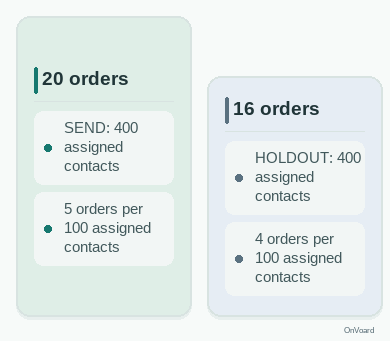
For a separate next-campaign test, Nora randomly assigns 800 eligible customer identities to two persistent groups before sending: 400 receive the campaign and 400 are held out. Both groups keep ordinary flows, prices and availability comparable. Service messages and the promised signup guide continue. The observation period is the same seven days for everyone.
The send group places 20 orders; the holdout places 16. That is 5 orders per 100 assigned contacts versus 4 per 100. The point estimate is four additional orders for the 400-person send group.
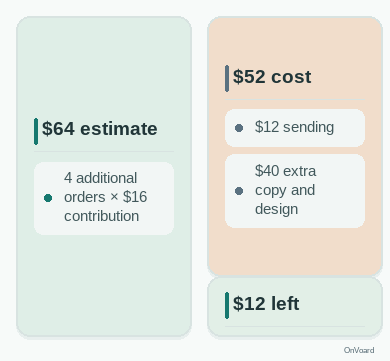
At $40 net merchandise revenue and $16 variable contribution per order, the estimated difference is $160 in revenue and $64 in contribution. Subtract $12 sending cost and $40 extra copy and design cost: the incremental contribution point estimate is $12.
That small observed difference is noisy. It is not a statistically established win, and no significance claim follows from these counts. Reconcile later returns, check whether held-out people received the campaign through another list or resend, and review differences in ordinary-flow exposure. Keep assignment at a stable identity so duplicate profiles do not put the same person in both groups.
The decision is to continue learning before increasing frequency. Set the primary commercial outcome and observation window before launch, examine unsubscribe and complaint harm alongside it, and choose a test large enough for the decision when volume permits. At low volume, inspect customer questions and buying friction rather than declaring a winner from a handful of orders or an open-rate change.
Price the discount before testing it
A separate Autumn Sampler calculation uses its $36 price and an assumed $21 variable cost. Contribution is $15 per order. Taking $3 off lowers it to $12. To preserve the same contribution, order volume must be 15 divided by 12, or 1.25 times as large: a 25% increase, before additional sending or creative costs.
That example assumes unchanged costs, returns and product mix. Nora keeps the launch at full price. A discount becomes a testable commercial choice with a break-even target, not an obligatory block in a flow template.
Turn evidence into next week's work
Different evidence supports different decisions. The sender audit supports keeping one recovery owner; the campaign brief rules out the unchanged launch reminder. The November scorecard reconciles overlapping order credits and bounds the financial claim, but cannot identify a winning campaign or prove a stale branch exists. The separate holdout result does not justify increasing frequency. A failed purchaser-before-wait test would justify pausing the affected persuasion path.
When performance or customer experience deteriorates, inspect the path before rewriting unrelated copy.
Symptom | Evidence to inspect first | Owner and immediate action |
|---|---|---|
Expected email never sends | Event receipt, identity match, permission, suppression, eligibility and exits | Nora traces one profile; Ellis repairs missing source data. Keep the path paused if safe qualification is impossible. |
Duplicate or stale reminder | Checkout/order IDs, occurrence versus ingestion time, every sender's log and waiting jobs | Nora pauses affected persuasion and retires duplicates; Ellis investigates late order events. |
Sudden bounce or complaint rise | Provider feedback, authentication, new list sources, recent volume and suppression sync | Nora pauses the affected audience; Ellis checks configuration with the provider. |
Clicks without orders | Exact link, current stock, variant, price, mobile product page and checkout errors | Nora checks message-to-page consistency; Ellis fixes the broken destination or checkout. |
Attributed revenue suddenly jumps | Attribution settings, lookback, order-ID overlap, refunds and changed export units | Nora reconciles the report before allocating more budget. |
Repeat buying weakens | Mature purchase cohorts, product availability, order problems and actual buying intervals | Nora checks the commercial reason to return; Ellis resolves service or stock issues. |
Discount reaches the wrong buyer | Code eligibility, prior purchases, expiry, stacking and actual checkout behavior | Nora stops the affected offer until the rules and destination agree. |
Prove the path before activating it
Nora keeps a compact test record with the profile, event, expected result and observed log. Ellis supplies representative order states. Run these cases after changing the relevant flow:
A new subscriber receives the promised guide; a prior buyer avoids first-order language.
A purchaser before the recovery wait ends exits recovery. Repeat with delayed event receipt to expose the integration's limitation.
Iris's opt-out cancels queued marketing in every active marketing sender.
A duplicate checkout event creates no duplicate send or unintended re-entry.
A refunded order leaves messages whose only basis was that purchase.
A late-delivery case receives truthful service handling while experience-dependent education and reviews wait.
A failed, unavailable or wrong-product destination blocks the affected campaign until corrected.
Also test blank personalization, live text with images blocked, mobile and dark-mode rendering, sender and reply identity, unsubscribe behavior, offer eligibility and reporting records. If an observed result differs from the expected one, Nora pauses that path, records the cause and reruns the failed case after repair. A successful template preview does not replace a flow test.
Choose software around the work you need
Before choosing or expanding a platform, ask it to demonstrate the actual store events and identifiers you need, permission and suppression synchronization, fresh eligibility checks, exits and re-entry, customer-level send visibility, usable test logs and exportable reporting. Check which controls span campaigns and flows, which span separate apps, and which require manual work.
Include fixed fees, contact or usage charges, implementation effort and ongoing staff time in the cost comparison. A sophisticated feature unused by a small store still has an operating cost. Later capabilities can wait until the audience and question justify them.
OnVoard's Marketing Platform lists campaigns, segments and store-event workflows, making those the appropriate capabilities to investigate for this plan. Verify your specific event coverage and operating controls before relying on them; the program described here does not assume a native cross-app priority engine or delivery-issue feed.
Before the October 12 calendar begins, Nora and Ellis finish the sender register, permission checks and representative tests. Only the paths that pass enter the calendar; a failed recovery check pauses recovery without cancelling unrelated service messages. During the month, Nora checks exclusions before each campaign and Ellis maintains the order exceptions. The November review then determines which path to repair or experiment with next. A new shop can begin with fewer active paths rather than borrow this established store's launch date.
Each week, Nora reviews actual customer-level sends, exceptions, delivery feedback and broken destinations with Ellis. Each month, they reconcile orders and costs, inspect acquisition and repeat-purchase cohorts, and retire messages that have lost their job.
Their next action is concrete: Nora runs the purchaser-before-wait test while Ellis checks when purchase events arrive. If obsolete persuasion remains queued, Nora pauses that branch and they repair and retest it before activation. If the test passes, they retain the result in the test record. Either outcome gives the next decision evidence the aggregate revenue report cannot supply.