On this page
Start a winback campaign with one group of past buyers, a reason they might shop again, and a clear end to the series. Choose the audience from its buying cycle before choosing a discount. If you can't establish that someone is overdue, still eligible for marketing, and likely to find the offer relevant, leave them out until you can.
A winback campaign is a bounded attempt to bring a previous customer back after a longer-than-expected gap between purchases. That gap means something different for coffee, table linens and a dining table. A useful campaign connects what the person bought with a plausible next purchase; it doesn't assume that everyone who has been quiet for 90 days needs the same email.
Separate customer lapse from other recovery jobs
Use purchase history to decide whether winback is the right follow-up. Email activity can help you understand contact risk, but an open doesn't establish that someone has returned as a customer.
What you know | Start with |
|---|---|
A previous buyer is beyond the store's trial repurchase window | A relevant winback treatment |
A customer is approaching a normal replenishment point | A replenishment reminder |
A person recently left an unfinished checkout | Checkout recovery |
A subscriber has never purchased | First-purchase nurture |
Purchase history or current marketing eligibility is unknown | Resolve the missing information before sending |
A lapsed buyer can also have an active checkout. Give that immediate buying decision priority rather than sending recovery and winback together. Someone awaiting help with a damaged order needs service before another promotion. These decisions belong in audience selection, not in a clever subject line.
Keep customer lapse separate from email disengagement. With Apple's Protect Mail Activity enabled, remote content can load in the background when mail arrives. An apparent open therefore isn't reliable evidence of a person reading, much less buying. A campaign to confirm whether someone still wants promotional email has a different job from a campaign to earn their next order.
For a first version, use a small, explainable group with a current marketing relationship. An old list of everyone who ever bought is a poor starting audience. Past purchase, reachable address and permission to market are separate facts.
Use one bounded 3-email sequence
Here is a complete example before the audience calculations and setup details. Field & Table is a fictional homewares store. It has chosen a provisional 120-day boundary for a small group of previous linen buyers. A customer 150 days past a qualifying order, with no later purchase or exclusion, can enter this trial. The boundary is an operating hypothesis, not evidence that linens need replacing after 120 days.
The offer is a modest table refresh. The first message presents a relevant choice, the second answers a fit question, and the third offers a smaller alternative. There is no discount to expire and no invented shortage. If those later messages don't add useful information for your audience, shorten your own campaign rather than filling 3 slots.
The products, prices, dimensions and care instructions below are invented; all prices are USD. Use verified catalog facts before sending. The CTA labels describe the pages to build or select, rather than linking to pretend live products. Map the footer merge fields to your sending system's real business address and working unsubscribe control.
Email 1: Offer a relevant next purchase
Send at campaign entry, after the eligibility check.
Subject: A table refresh without a whole new set
Preview text: A runner for the center, or placemats for everyday meals.
Hi there,
You don't need to replace all your table linens to change how the table feels.
Our Oat Cotton Runner leaves the tabletop visible and gives serving bowls a place down the center. It's 180 × 35 cm and costs $32.
Prefer individual place settings? The Slate Cotton Placemats come as a pair for $18. Each measures 45 × 30 cm, so you can add just the places you need.
Both are machine washable on a cold, gentle cycle. They are table linens, not heatproof pads; keep hot pans on a suitable trivet.
See the table refresh edit
Field & Table
{POSTAL_ADDRESS} · {UNSUBSCRIBE_LINK}
Customize: Replace the fictional catalog details, connect the CTA to a short collection containing those items, and verify the footer fields in an actual test message.
This email earns attention with a manageable choice. It doesn't claim the products are new or personally selected by an algorithm. The landing page should make the same choice easy: show the runner and placemats first, with prices, dimensions and stock. Sending readers to the entire catalog would undo the useful narrowing in the email.
If the customer's original purchase is a known color, you can select a compatible option only when the catalog relationship is reliable. A purchase of a gift should not become “complete your dining room.” Where ownership or taste is uncertain, keep the wording neutral as this example does.
Email 2: Answer the measurement question
Send 5 days after entry if the customer still qualifies. This is a new buying aid, not a repeat of the first offer with a louder subject.
Subject: Runner or placemats? Start with your table size
Preview text: Here's how the 180 cm runner fits a 160 cm table.
Hi there,
If you were weighing up the runner and placemats, measure the table before choosing.
On a rectangular table 160 cm long, our 180 cm Oat Cotton Runner leaves 20 cm beyond the tabletop: 10 cm at each end when centered. On a 200 cm table, it won't hang over either end.
For a table you use one place at a time, the Slate Cotton Placemats may be more practical. Each is 45 × 30 cm. Check that footprint against your plates and the space between seats before ordering.
The fit guide shows both layouts, including the dimensions. A runner won't protect the whole tabletop, and neither option replaces a heatproof pad.
Check the runner and placemat fit guide
Field & Table
{POSTAL_ADDRESS} · {UNSUBSCRIBE_LINK}
Customize: Use your actual product measurements and publish the promised fit diagrams at the CTA destination. Check the calculation for each size you sell.
The wording doesn't pretend the store knows that this particular reader clicked or compared products. “If you were weighing up” introduces a useful possibility without inventing behavior. A fit guide is worthwhile when fit is a real source of hesitation; for a product where size is obvious, answer another purchase question instead.
Check the destination as a shopper would. Can someone see the measurements without creating an account? Does the illustrated size match the variant that can be ordered? If the guide describes an unavailable runner, update the offer or hold the message before it reaches more people.
Email 3: Offer a smaller choice and end the series
Send 7 days after email 2, which is day 12 from entry, if eligibility still holds.
Subject: A smaller change for everyday dinners
Preview text: 4 cotton napkins, with no table-size decision.
Hi there,
If a runner or placemats aren't what you need, here's one last idea from the table refresh edit.
Our Everyday Cotton Napkins are a set of 4 for $24. Each is 40 × 40 cm, with a plain stitched edge and no pattern to match. Choose Oat or Slate to work with the linens you already use.
Machine wash cold with similar colors and air-dry. Cotton can crease; choose these if you like a relaxed finish rather than a permanently crisp, wrinkle-free look.
See the Everyday Cotton Napkins
This is the last email in this table refresh series. If you're already receiving our other marketing emails, those preferences stay the same. You can unsubscribe below.
Field & Table
{POSTAL_ADDRESS} · {UNSUBSCRIBE_LINK}
Customize: Replace the napkin details and product destination, then confirm that this really is the final message in the series.
The smaller option reduces the decision without inventing a sale. The ending is also precise: this series finishes, while existing marketing preferences remain in effect. Don't say “you won't hear from us again” if a weekly newsletter is still scheduled.
Keep the subject, preview text, finished copy and CTA together when adapting these messages. For visual hierarchy and responsive layout, use the separate email template layout guide. The winback decision is whether each message has a useful reason to arrive at all.
Control entry, waiting, exits and reentry
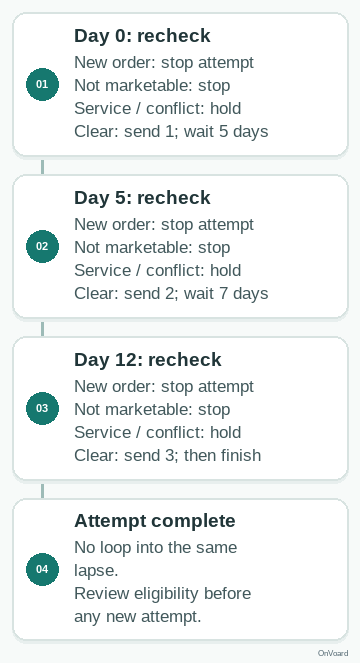
Treat the campaign as one attempt during a specific lapse. Its timing starts at admission: day 0, day 5 and day 12 in the Field & Table example. Those are illustrative choices, not proven optimal delays or a promise to send at an exact hour.
Before each planned send, confirm the person still belongs in this campaign. A new qualifying order ends the attempt. An unsubscribe or other marketing suppression prevents further promotional sends. An unresolved service issue or competing recovery flow puts the promotion on hold under the store's policy. When the final message is complete, mark this attempt finished.
Distinguish a hold from an exit. A customer waiting for a replacement parcel might become eligible for a useful offer later, but resolving the complaint should not automatically release a stale email. Reconsider the offer, current purchase history and pressure before resuming. The original napkin stock or seasonal message may no longer be suitable.
Make a new purchase after entry the simplest purchase-exit rule for your first campaign. Suppose a linen buyer purchases a gift on day 3. Even if it isn't another linen order, they have returned to the store; carrying on with “come back” messaging is unnecessary. A category-specific follow-up can be a later decision, with its own reason, rather than an exception quietly keeping this sequence alive.
For reentry, start conservatively: one attempt per customer while you learn. If you later allow repeat entry, require a new qualifying purchase followed by a new lapse, or a separately defined cooldown and fresh review. Remaining in the same inactive segment is not a new event worth another 3 emails.
Record the attempt's entry, last step and completion using fields or history your tools actually support. Check what happens to those records after a workflow edit, migration or history cleanup. “Already sent” protection that disappears with old history is not a dependable once-per-lapse rule.
Calculate a lapse boundary from mature order history
Use people with enough time to make another purchase. Otherwise, recent first-time buyers will appear inactive simply because they have only had a few days to return.
Start with a clearly defined qualifying order. For example, count paid, non-test orders after cancellations and full refunds are reconciled. Decide how exchanges and replacement orders behave so a free replacement doesn't masquerade as a new buying decision. Use the same definition for audience selection and later measurement.
Then choose a comparable group: similar product category, first-time versus established buyers, and a relevant season. A mixed export of coffee refills, gift boxes and equipment purchases is difficult to interpret because those orders imply different next needs.
A worked coffee cohort
Cedar Coffee is fictional, and these counts are constructed teaching data. Take 200 comparable buyers and observe each for 120 days after a qualifying order. Every person has the full follow-up period. Each appears once, in the interval containing their next qualifying purchase; gift orders and active subscriptions are classified separately before this comparison.
Next qualifying purchase | Buyers |
|---|---|
Days 0 to 45 | 90 |
Days 46 to 60 | 30 |
Days 61 to 90 | 20 |
Days 91 to 120 | 10 |
No next purchase observed by day 120 | 50 |
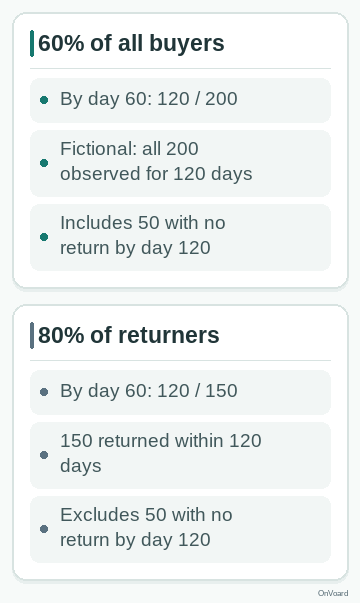
By day 60, 120 of the original 200 buyers returned: 60% of the starting group. Among the 150 who returned at some point within 120 days, those same 120 represent 80% of returners. Both calculations are correct. They answer different questions.
Using only returners would hide the 50 people who hadn't returned by day 120. It could make the usual buying cycle appear more reassuring than the complete customer picture. Conversely, those 50 aren't proven permanently lost. Their next purchase may happen after the observation window.
Cedar chooses day 70 as a trial winback boundary, giving customers time beyond the period in which a majority of this group returned. The table does not prove that day 70 is best, or even reveal exactly how many purchases happened by that day: the 61-to-90-day bin is too broad. To compare candidate boundaries properly, retain the underlying order dates and examine later outcomes rather than pretending the bins contain that detail.
Now consider 20 new buyers whose first orders were only 10 days ago. Adding them to the denominator would reduce the apparent return rate despite giving them far less opportunity to buy again. Keep them out of this completed 120-day comparison and follow them into a later, equally mature group.
Turn the observation into a usable rule
Write the trial rule before building the segment. Cedar's repeat-buyer version might be: marketable customers with a known coffee purchase history, no qualifying new store order for at least 70 days, no active subscription covering that product, and no service or campaign exclusion.
A customer at day 66 waits. A comparable customer at day 80 is a candidate, provided the other conditions hold. Someone at day 85 with missing linked orders stays out until identity and history are reconciled. Missing data must not count as evidence of inactivity.
Review first-time buyers separately from established repeat buyers. A store with strong repeat-customer intervals may still have many first-time shoppers who never make a second order. Their obstacle could be uncertainty about the product, delivery experience, fit or lack of another relevant item. Copying the repeat-buyer's replenishment message won't identify which explanation applies.
When history is sparse, use a small manual audience you can inspect and treat the threshold as provisional. Ask what reason makes contact appropriate now. If you cannot answer that for a durable or gift-heavy product, keep the automation inactive and gather more history. Waiting for usable evidence is better than treating a borrowed 90-day or 180-day preset as your store's buying cycle.
Choose treatments for 3 different stores
The following decisions use fictional merchants. The differences in timing and offer come from the product and the customer relationship, not from a claim that one sequence works everywhere.
Cedar Coffee: Make a familiar reorder easy
Cedar has a marketable repeat buyer 80 days after the latest qualifying order. The store's trial boundary is 70 days, the customer isn't on an active subscription, and there is no unresolved delivery issue. Admit this customer to a small reorder-focused test.
The useful treatment is a route back to the familiar coffee, with current availability and a choice of bag size. If the original roast is discontinued, explain the verified replacement characteristics rather than quietly swapping products. Avoid asserting “you've run out”: a person may have bought elsewhere, changed habits or purchased more than one bag.
An active subscriber should not receive the same “time to reorder” campaign simply because their last manually placed order is old. Check whether subscription orders are included in your data and whether an upcoming delivery already supplies the product. A prior gift purchase also doesn't establish personal consumption. Exclude those situations from this test until you have a relevant treatment for them.
Stop this attempt after a new order or loss of marketing eligibility. Evaluate repeat purchases and contribution over a predeclared follow-up period, with subscription and gift cases kept out of the comparison. A shorter reorder path is the reason to test; no reduction in acquisition cost or revenue lift is assumed.
Field & Table: Help with a complementary choice
Use the homewares buyer introduced with the sequence. Choose the complementary-purchase treatment only when the earlier order gives you a credible next use. Another tablecloth in the same size may simply duplicate what the customer already has. The runner-versus-placemat choice offers a smaller change with a practical fit decision.
Check whether the past experience supports that invitation. A complaint that the fabric was unsuitable calls for resolving the mismatch before suggesting more of it. When the order was a gift, the purchaser may have no matching table setting at home; exclude that assumption rather than writing around it with a larger discount.
For this group, inspect whether the fit-help destination leads to relevant purchases with worthwhile contribution. If readers repeatedly reach the guide but cannot find a suitable size, improve the assortment or recommendation before adding another reminder. Apply the campaign's existing stop rules rather than creating a special exemption for a promising click.
Northlight Furniture: Find a real new need, or send nothing
Northlight sold a dining table several months ago. Do not transplant Cedar's 70-day timer or the linen store's 120-day sequence. A durable table has no predictable replacement need at either point.
A compatible bench may be a useful later purchase if dimensions, finish and availability are known. The store can make a bounded invitation around that actual fit, with a destination that shows the measurements. A care accessory can also be relevant when its use is supported by the product instructions. Neither requires pretending the table owner has become dissatisfied or needs replacing furniture.
Suppose the order was a gift, delivery remains unresolved, or the original table's size is missing. Hold the promotional invitation. The first fact prevents an ownership assumption, the second calls for service, and the third makes a compatibility claim unreliable. Sending a bigger coupon would not solve any of them.
If there is no genuine next need, choose no promotional winback. A relevant seasonal collection may create a future reason, but the season must fit the audience and product. For a later test, measure qualified accessory purchases and their contribution over the declared window, rather than calling every returning visit a recovered customer.
Price the reason to return
Try a useful non-discount treatment when it addresses the buying obstacle. A familiar reorder, a practical fit guide, a genuinely improved product or an already-earned usable benefit can each justify a message. A discount is worth considering when price is a plausible barrier and the economics leave room to test it.
A $10 discount can require substantially more orders just to preserve contribution. In this fictional USD example, a $60 order has $25 of product cost and $10 of other variable costs. It leaves $25 before campaign costs and fixed overhead. Take $10 off, with those costs unchanged, and net sales become $50 while contribution falls to $15.
Per-order measure | No new discount | $10 discount |
|---|---|---|
Net sales | $60 | $50 |
Product and other variable costs | $35 | $35 |
Contribution before campaign costs | $25 | $15 |
To match the contribution from 100 full-price orders, the discounted version needs $2,500 ÷ $15, or about 167 otherwise-equivalent orders. That's roughly 66.7% more orders before any extra campaign cost. Different basket contents, shipping, payment fees, returns or redemptions change the calculation.
Translate that into customers assigned to a test. Assume, purely for illustration, that 6% buy without a new discount and 9% buy with it. At one order per buyer, the first treatment produces $1.50 contribution per assigned customer: 6% × $25. The second produces $1.35: 9% × $15. More purchases can still leave less contribution. The discounted treatment needs a 10% purchase rate to match $1.50 under these assumptions.
Those response rates are invented inputs, not expected results. Use this calculation to decide what improvement an offer would need, then test whether that improvement happens. Don't work backward from the desired answer by assuming that customers will respond strongly enough.
Free shipping and gifts also need a cost calculation. Include the extra shipping subsidy, product cost, pick-and-pack work and any threshold-induced change in basket contents. An unused loyalty benefit is different from issuing a new discount: verify that the customer can actually redeem it, that the benefit is relevant, and that another promotion doesn't create unintended stacking. The loyalty program economics guide covers the broader reward design.
Before an incentive test, settle eligibility, minimum spend, exclusions, stacking, expiry and returns treatment. Put material conditions where the shopper can see them before committing. Use an expiry only when the offer really ends then; a rolling false deadline gives the customer a misleading reason to act.
Coordinate channels and marketing pressure
Email is a practical starting point for the worked sequence because it can carry product details, buying help and a clear destination. Adding another channel should solve a specific problem, not simply increase the number of reminders.
Situation | Sensible next decision |
|---|---|
The buying decision needs measurements or several product facts | Keep the detailed help in email or its linked page |
A brief reminder has a clear purpose and valid eligibility for that channel | Consider it within the same campaign plan |
A customer opted out of a channel | Honor that choice; don't use another channel as a workaround |
Purchase and suppression state cannot be coordinated reliably | Keep the campaign simpler until they can |
Use the current channel-specific marketing eligibility and applicable rules before any SMS, push or other promotional contact. Email eligibility does not establish SMS eligibility. Retargeting audiences and permissions also require their own checks; an email address in your customer file isn't automatic authority for every advertising use.
Inspect the person's combined schedule. A winback email, a general sale and an automated checkout reminder can all be individually plausible and collectively excessive. Assign one owner to decide which promotional message has priority and what happens to the others. Don't assume different apps share a global frequency limit or update each other's exclusions.
If the store can't coordinate that reliably, suppress the overlapping campaign or begin with email alone. Keep necessary order and service communication separate from discretionary promotions. The whole-store email program guide covers that wider scheduling problem; this winback campaign should fit into it.
Map the campaign to OnVoard controls
OnVoard documents a Winback playbook and workflow steps including emails, delays, filters and branches. Use the workflow guide to find the existing structure, then adapt it to your audience and message plan. A preset is a starting point; it doesn't establish that your chosen threshold, exclusions or exits are already configured.
Build the audience from purchase activity and the contact conditions available for your connected store. OnVoard's contact segment guide explains segment-entry triggers and gives a Repurchase Opportunities example using no order within 180 days. That number belongs to the example, not to a universal recommendation for your catalog.
Use entry requirements for admission and workflow-membership restrictions. Use workflow requirements for conditions that must remain true after admission. OnVoard checks these at entry and during normal email and action step processing, and exits contacts when the requirements fail. Configure and test the no-new-purchase condition instead of relying on the segment snapshot at entry.
Keep conditions grounded in data you actually have. An unresolved service issue may need a maintained tag, exclusion list or manual review if your support status isn't connected. Subscription and gift exclusions need reliable records too. The recommended campaign design doesn't imply that every store integration supplies every field or that the workflow automatically knows these facts.
Allow for evaluation and processing time. A customer crossing a time-based threshold is not the same event as completed segment evaluation or email delivery. Scheduled evaluation can lag, and queueing adds another step. Avoid promising an exact send time or relying on a universal maximum wait. Test the actual path, including retries, before treating the intended stop behavior as proven.
Keep your first configuration small enough to inspect: one qualifying group, one sequence, a named owner and explicit exclusions. Expand after the representative tests below show what your installed setup does.
Test contacts before activating the flow
Create representative test profiles or use an approved testing setup that cannot accidentally contact real customers. Record the expected result, the actual membership and message history, and any mismatch. The following are tests to perform, not claims that a particular store or platform has already passed them.
Eligible buyer: A marketable Cedar customer at day 80 with complete history should enter the stated trial once.
Too recent: The same customer at day 66 should stay out.
Active subscription or gift: The relevant exclusion should prevent the personal-replenishment treatment.
Unknown history: A profile with unmatched or missing purchase records should not become eligible merely because no recent order appears.
Purchase during a wait: A new order after message 1 should prevent messages 2 and 3 under the configured purchase-exit rule.
Marketing opt-out: An unsubscribe during the wait should prevent later promotional sends, including any queued retry path you rely on.
Service issue or competing recovery: The defined hold or exclusion should occur, with a person responsible for reconsidering the campaign.
Duplicate entry and completion: Repeated segment changes or the same event should not start parallel attempts. Completing message 3 should not immediately restart the sequence.
For a delayed order event, record both when the purchase happened and when the marketing system learned about it. If a 10:00 purchase arrives at 10:20 after a 10:10 send decision, a rule based on the system's current data couldn't act on the missing event. Investigate ingestion delay and the operating safeguard rather than declaring the contact rule correct because it eventually exited. Test again after the cause is understood.
Also send the actual message to your permitted test addresses. Check sender identity, subject, preview text, mobile readability, images-off meaning, every CTA and the working unsubscribe link. Confirm prices, variants, stock and offer conditions at the destination. A good audience rule doesn't rescue a message that lands on an unavailable product.
Keep the campaign inactive when purchase or permission exits fail. Fix the specific control, reproduce the failing case and retain the observed result before launch. If your stack cannot implement a required exclusion safely, reduce the audience to one you can manage rather than hiding the limitation in copy.
Measure additional contribution
Choose the outcome and observation window before sending. Count unique purchasers per assigned eligible customer, with the same follow-up period for everyone. Also reconcile net sales, discounts, refunds, variable costs, complaints and unsubscribes. Delivery and clicks can explain friction, but the campaign's business decision is whether it adds worthwhile returning purchases.
OnVoard's documented email conversion tracking uses last-touch attribution with a configurable lookback window for viewed or clicked emails. That tells you which email receives credit under the rule. It doesn't establish that every credited order happened because of the winback campaign.
For a stronger comparison, randomly reserve an eligible holdout group that does not receive this series. Assign customers before any winback contact and keep their assignment stable. Don't use “people who didn't open” as the control: they weren't randomly assigned and may differ from those who opened. Keep other treatment comparable, including storewide promotions and necessary service communication.
You may need a separate experiment process to maintain assignments and combine order and cost data. The method here is not a claim that OnVoard provides a native holdout estimator or a particular randomization screen.
More returning buyers can still lose contribution
This is a separate fictional experiment using a 30-day observation window from assignment. Assume the groups were randomly assigned, other treatment was comparable, costs and refunds were reconciled, and each purchaser made exactly one order. Those simplifying assumptions make the arithmetic visible; they are not measured campaign results.
Measure | Winback treatment | No-series holdout |
|---|---|---|
Customers assigned | 4,000 | 1,000 |
Unique purchasers within 30 days | 240 | 40 |
Purchase rate | 6% | 4% |
Average contribution per order | $15 | $25 |
Total order contribution | $3,600 | $1,000 |
Contribution per assigned customer | $0.90 | $1.00 |
The observed purchase-rate difference is 2 percentage points. Applied to 4,000 treated customers, that gives an estimate of 80 additional purchasers, not 240 proven additional purchasers.
The contribution result goes the other way. Treatment averages $0.10 less per assigned customer. Across 4,000 customers, the estimated difference is negative $400 before campaign costs. Subtract a further $120 of campaign cost not already included, and the point estimate becomes negative $520.
Do not scale that incentive just because the order rate or attributed revenue looks better. Investigate a lower-cost treatment or a more relevant audience, keeping the original result. This example also shows why comparing the raw $3,600 and $1,000 totals would mislead: the treatment group is 4 times larger.
Report uncertainty as well as the point estimate. The observed difference can vary by chance, and contribution is affected by order mix and returns. Use actual customer-level outcomes to estimate uncertainty before declaring a statistical winner. In a real store with varying baskets and returns, summary totals and averages alone don't provide the variation needed for a contribution interval. A small audience may support only a directional finding.
Measure by assignment even when some messages weren't delivered. Dropping undelivered customers from one side changes the original comparison. Separately inspect delivery problems so the next test is better informed. If a customer places several orders, include all qualifying order contribution consistently rather than assuming one order as the illustration does.
Finally, avoid double-counting incentive cost. Net sales already reduced by a discount should not have that same discount subtracted again. Apply the same refund, tax, shipping and cost conventions to both groups. Label the result contribution after the included costs, not total business profit.
Use the result to change the next campaign
After the full observation window, choose a specific next action rather than changing subject lines, audience and incentive together.
Wrong people entered or messages continued after a stop condition. Inspect identity, order history, requirement evaluation and event timing first. Pause the affected path while it is unreliable. Persuasive copy is not the repair for incorrect admission or suppression.
People clicked but didn't buy. Check the exact destination, available variants, product fit, shipping and checkout before adding a discount. For Field & Table, inspect whether the fit guide resolves the runner question and whether the linked size is available. A generic homepage or unavailable item gives you a concrete fix to test.
Purchases increased but contribution did not. Revisit the incentive and product mix. Use the per-assigned-customer comparison to test a less costly reason to return, rather than treating additional attributed orders as sufficient success.
The sample is too small to choose a winner. Keep the uncertainty visible. Improve demonstrated friction, retain stable measurement and wait for a genuinely comparable group instead of announcing a lift from a handful of orders.
Assign the next check to someone and give it a date after the relevant data will be available. A campaign owner should be able to say which audience is active, which attempt a customer is in, why the next message is useful, and what result would justify continuing it.