On this page
Start with products that complete 1 shopper task, keep a useful standalone alternative, and price the bundle against what that shopper would otherwise buy. A discount comes after those decisions. Adding a third item makes little sense if the customer needs 2, and a higher order total can leave you with less contribution.
The right composition changes when customers already own equipment, use products at different speeds or receive something later. These 20 product bundling examples compare those decisions, followed by 4 fictional pricing models to adapt to your store.
Use the shopper's immediate problem to find the closest starting point:
Starting something: Harry's, Blueland and CandleScience show different definitions of a complete kit.
Getting the fit right: Sonos, Kylie, Glossier, Brooklinen, Ooni and GoPro make compatibility and component choice consequential.
Choosing an assortment or gift: Death Wish Coffee, Fly By Jing and Jeni's expose different costs of curation.
Receiving something later: Tatcha, Sephora, Trade and Nintendo separate products from future discounts, deliveries and entitlements.
Building a personal selection: Bombas, Away, Le Creuset and ButcherBox use different rules for quantities and price.
20 product bundling examples
Merchant contents and terms below were checked on October 13, 2026. Dollar prices are US dollars from the linked US offers; Harry's is the specified UK set, without a price comparison here. Prices and eligibility can change.
1. Harry's: complete the first use
Harry's UK Plus Starter Set combines a razor, blade cartridge, shave gel and travel cover. The offer also provides a no-subscription option. A new customer can get the equipment and consumable needed to try the shaving routine without treating that first purchase as evidence of a recurring commitment.
The useful comparison is the customer's missing-items list. Someone switching razor systems may need the handle and cartridge but already have shave gel. An existing owner may need replacement blades alone. Those are different baskets, even when the same starter set could technically serve both customers.
Define what customers can do after opening your kit and which ordinary supplies they must already have. Include the parts whose absence would interrupt that first use, and explain the role of any convenience accessories.
A starter set is a sensible entry offer when the equipment choice creates uncertainty for newcomers. Keep refills easy to find for existing owners, and evaluate the first order on its own costs. Later purchases can improve the customer relationship, but they should not be assumed when deciding whether the introductory price is affordable.
2. Blueland: separate reusable equipment from replenishment
Blueland's Clean Essentials Kit covers hand soap, multi-surface cleaning, bathroom cleaning, and glass and mirror cleaning. Each product has a reusable bottle and a refill tablet. Its refill collection gives households a way to replenish the contents separately.
Here, the decision continues beyond the first use. A household can own all 4 bottles and still need only bathroom cleaner. A fixed repeat of the starter composition would send durable equipment again; a fixed equal refill assortment could leave a slower-used product accumulating in the cupboard.
This is the point to separate what stays with the customer from what gets used up. The same distinction applies to dispensers and concentrates, jars and refills, or reusable applicators and replacement material. Build the starter offer around installation, then decide whether replenishment should be individual, configurable or grouped in unequal quantities.
Do not infer a replenishment interval from the number of products in the kit. Consumption depends on the household and the task. Use order history or customer feedback to decide what should disappear from the next order and what should change quantity.
3. CandleScience: match the contents to a finished output
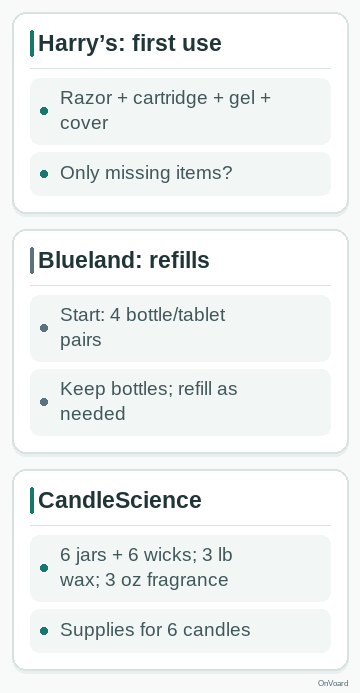
The SimplySoy Starter+ Candle Making Kit is intended to make 6 candles. Its supplies include:
6 jars with lids and 6 each of wicks, wick stickers, wick bars, warning labels and product labels
3 1-pound wax bags and 3 1-ounce fragrance bottles
A digital thermometer and instructions
Customers can take a preselected fragrance trio or choose 3 fragrances.
That changes how you assemble the bill of materials. A photograph showing 1 of every ingredient would be a poor guide to the quantities needed. Count the limiting consumable against the intended output, then check the vessels, finishing materials and labels that make those outputs usable. A missing low-cost component can leave an expensive kit unfinished.
For a craft or food-preparation store, begin with the batch size and work backward. Keep optional aesthetic choices, such as scent or color, separate from quantities required by the instructions. Pack and complete a sample project before launching; supplier quantities alone do not prove that your own instructions and packaging work together.
The thermometer also creates a different second purchase. Returning makers may want consumable supplies without another tool.
4. Sonos: choose the system capability and component ratio
The Sonos Immersive Set with Beam contains 1 Beam, 1 Sub Mini and 2 Era 100 speakers. The same page offers 2 useful comparisons:
The Surround Set combines Beam with 2 Era 100 speakers.
The Entertainment Set combines Beam with Sub Mini.
Those alternatives make the buying decision more specific than a choice between a small and large bundle. The surround configuration supplies the rear speaker pair; the bass-oriented configuration includes the subwoofer. The full set combines both. Its 1:1:2 component ratio matters because counting 3 product names would conceal 4 physical devices.
A merchant selling connected equipment should describe the capability added by each configuration. That gives shoppers a reason to choose a smaller set when it already meets their needs and a reason to buy the full system when the added function matters.
Keep prerequisites outside the inclusion claim. Sonos specifies a compatible TV and HDMI ARC/eARC for Dolby Atmos home-theater use; wall mounts are separate accessories. A photograph of an installed system can otherwise make placement equipment look included.
For your own catalog, verify the quantities and compatibility of the whole set before applying a price reduction. A useful system may deserve a bundle even at the sum of its component prices; its commercial value includes removing the work of assembling a functioning combination.
5. Kylie Cosmetics: coordinate a complementary pair
The Kylie Matte Lip Kit pairs a liquid lipstick with a lip liner. This is a merchant-coordinated offer: the buyer receives 2 different products intended to work within the same lip routine.
That pairing can help a customer who wants both products and would otherwise have to assemble the combination. It offers less value to someone replacing only a finished lipstick or someone who prefers a liner they already own. The useful alternative may be 1 constituent, not the combined individual price of both.
If you sell complementary products, choose the pair around a specific use and explain each product's role. The relationship can be aesthetic or functional, but it should be apparent before the buyer adds the pair to a cart.
Keep the initial decision narrow. A coordinated pair can spare the buyer a selection, but it also removes some freedom. If many shoppers need different versions of each constituent, a fixed pairing may be too restrictive. Glossier's next example addresses that problem by retaining separate fit decisions inside the combined offer.
6. Glossier: retain separate fit decisions within the pair
Glossier's Face Kit includes Perfecting Skin Tint and Stretch Balm Concealer, with component-specific shade choices. The offer groups the products while allowing the customer to select the appropriate shade for each.
This avoids treating 2 different product shade systems as if a single shared code necessarily resolves both. Compared with Kylie's coordinated lipstick-and-liner pair, the customer keeps more responsibility for the combination. That flexibility is useful when fit differs by product; it also creates more decisions before checkout.
The merchant's job is to reduce uncertainty without pretending the choice has already been solved. Explain what each product does, provide the relevant shade guidance, and show the final selections together in the order summary. Do not promise an automatic matching method unless your actual shopping flow provides one.
Separate choices also affect availability. A customer can find their preferred tint while the concealer they want is unavailable. Decide whether that situation should stop the combined purchase, offer a suitable alternative with consent, or leave a standalone route. Substituting a merely available shade would undermine the reason for offering independent fit.
7. Brooklinen: complete the bed without treating every size as identical
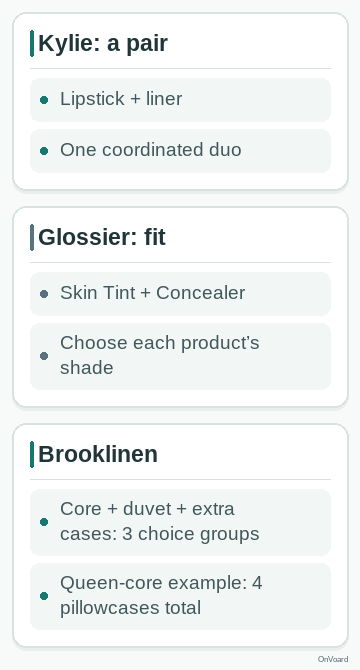
The Classic Percale Hardcore Sheet Bundle groups a Core Sheet Set, a Duvet Cover and an extra Pillowcase Set. In the verified Queen configuration, that means 1 fitted sheet, 1 flat sheet, 1 duvet cover and 4 pillowcases. Twin and Twin XL core sets contain only 1 pillowcase, so the total of 4 is not universal.
The 3 component groups can take separate sizes and colors. A Queen sheet set can remain selected while the duvet changes to King/Cali King; the extra pillowcase set has Standard, King and Euro sizing. These are choices for component groups, not independent customization of every physical sheet and pillowcase.
A single label such as “Queen bundle” therefore leaves an important question unanswered: which parts does that label size? A customer may have a Queen mattress, a larger duvet and pillows requiring a different case size. That possibility does not make mixed sizes the default recommendation. It means the order needs to describe the selected components accurately.
The larger commercial decision is whole-bed coverage versus replacement. A shopper furnishing a bed can use all 3 groups. Someone replacing worn sheets may already have a suitable duvet cover and enough pillowcases. Preserve that smaller purchase instead of assuming the most complete package creates the most useful order.
For household sets, define the fixed groups, their physical quantities and their individual fitting requirements.
8. Ooni: fit the equipment the customer already owns
Ooni's Essential Accessory Bundle combines a pizza peel, digital infrared thermometer and oven brush. Peel choices are 12, 14 or 16 inches, with Short or Long brush options. The oven itself is outside this bundle.
The appropriate peel depends on the installed equipment. Ooni's pizza peel compatibility table permits all 3 sizes for Koda 16, but only the 12-inch size for Koda 12. Koda 2 allows 12 or 14 inches. A larger peel can therefore be an unusable choice for a particular oven, regardless of whether the customer prefers it.
Unlike Sonos's full system, this offer works around an equipment purchase the customer has already made.
Ask for the equipment model before recommending a configuration, and retain a clear route for customers who need only 1 missing accessory. Someone with a suitable thermometer and brush should not have to buy duplicates to obtain the right peel.
When configurations have different prices, explain which combination a starting price represents. Avoid leading with the cheapest set before the shopper knows it fits. For an accessory store, compatibility errors can overwhelm the small convenience of a combined purchase through support work, returns and a customer who still cannot complete the intended task.
9. GoPro: build alternatives around the activity
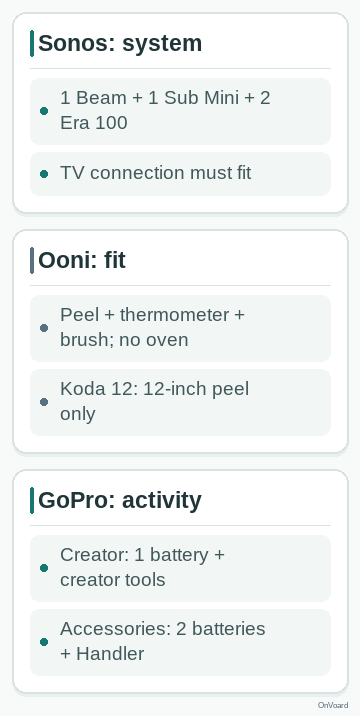
The HERO13 Black Creator Edition combines the camera with Volta, Media Mod, Light Mod, 1 Enduro battery, a Magnetic Latch Mount, a Curved Adhesive Mount and a carrying case. The same page's Accessories Bundle includes the camera, Handler, 2 Enduro batteries, 2 curved adhesive mounts and a camera case.
The extra light, media accessories and grip in the Creator Edition serve a different setup from the Handler and additional battery in the alternative. Counting accessories would flatten that distinction. A buyer who wants the second battery does not automatically need the light, and a customer assembling a creator setup may care more about the roles of the components than their number.
A good comparison therefore begins with the intended activity. Put the shared core product in the background and explain what changes between packages. This helps a merchant avoid creating a ladder where the expensive option is presented as better for everyone.
Returning customers add another constraint: existing accessories. GoPro states that HERO13's Enduro battery is incompatible with older GoPros, while the HERO13 body fits the HERO12 Protective Case and Media Mod. Customers need that component-level distinction before deciding how much equipment to replace.
Keep individual accessories available where practical, particularly for owners whose existing equipment already covers part of the package.
10. Death Wish Coffee: decide whether variety is actually wanted
The Light Roast + Dark Roast Bundle contains 1 16-ounce bag of each roast and is offered in Ground or Whole Bean format. The assortment is known before purchase; the buyer is choosing a particular pair of roast alternatives.
Compare that with 2 bags of a preferred roast. Both purchases provide the same total coffee quantity, but their usefulness differs for a household that strongly prefers one roast. Compare it again with buying just 1 wanted bag, and the larger order becomes a question of additional consumption rather than a simple saving.
For a merchant, a known assortment works when customers genuinely want variation or are choosing for people with different preferences. Put the identities and quantities in the offer itself. “Coffee bundle” is too vague to tell a customer whether the mix suits them.
Be careful with slow-moving stock. Adding an unwanted constituent can lower the amount a shopper is willing to pay for the whole set. If your customers repeatedly remove or avoid the same item, consider a choice-based assortment or a smaller pair.
11. Fly By Jing: include the work of making a gift presentable
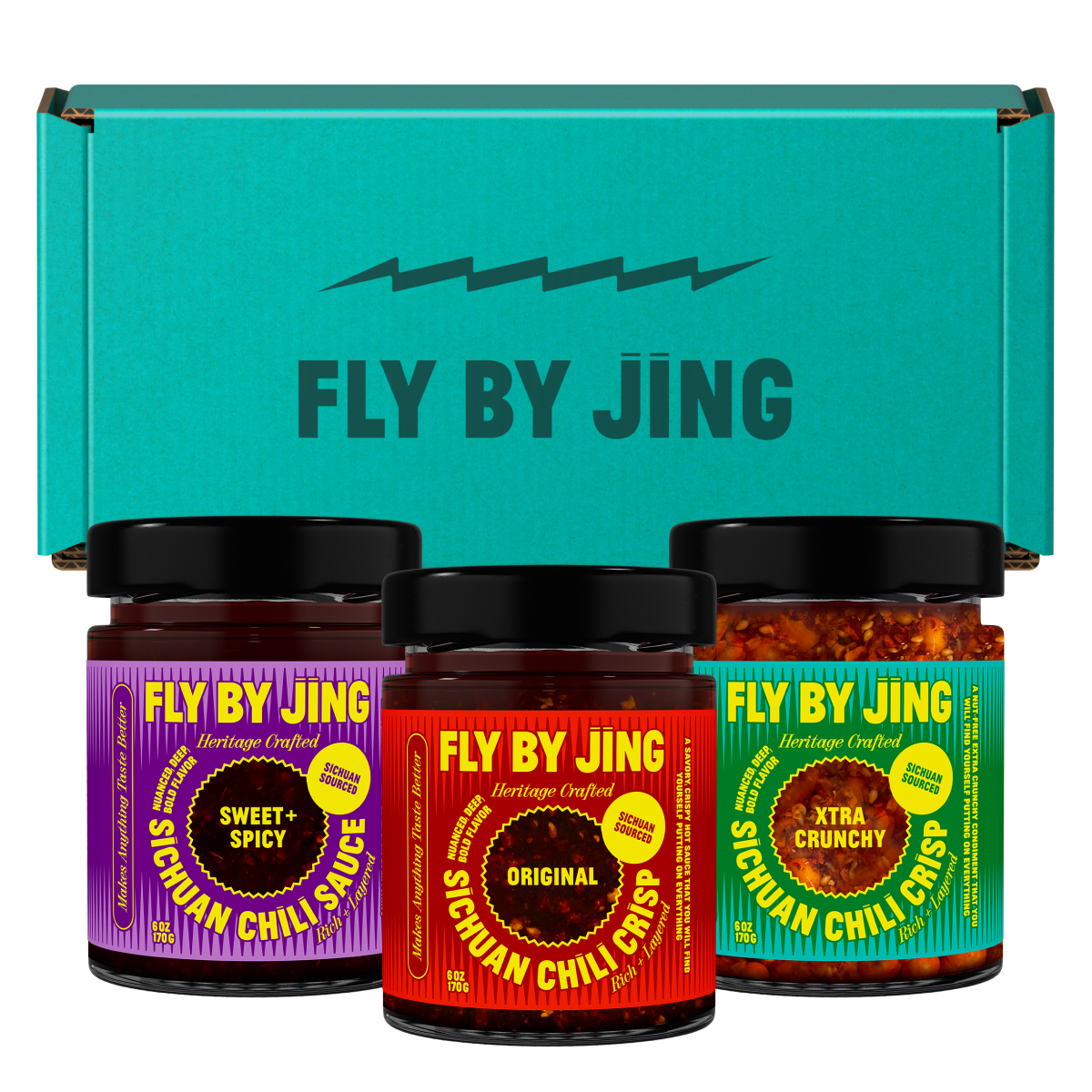
Fly By Jing's Chili Crisp Trio combines Original Sichuan Chili Crisp, Sweet + Spicy Sichuan Chili Sauce and Xtra Crunchy Sichuan Chili Crisp in a gift-ready box. Its gift guidance distinguishes that box from a gift note printed on the packing slip; separate gift wrapping is not offered. The product page was sold out at the October 13 check.
The comparison with loose jars includes work the purchaser would otherwise do: choosing a presentation, obtaining packaging and putting the gift together. That is a different reason to bundle than Death Wish's roast variety, even though both offers contain consumables.
For your store, identify exactly what “gift-ready” means. Does the recipient receive the illustrated box? Is the message a card or a packing-slip note? Are price documents removed? These details determine whether the purchaser can send the order directly to the recipient or still needs to handle it first.
Presentation also adds merchant costs. Pack a sample and measure the assembly time, protective materials and finished parcel. A premium is worth testing only if customers value the service and the price covers its delivery. Attractive packaging by itself is not evidence that the gift set earns more contribution than the same products sold loose.
12. Jeni's: curate around delivery and recipient readiness
Jeni's 6-pint Best Sellers Collection contains Brambleberry Crisp, Brown Butter Almond Brittle, Darkest Chocolate, Double Dough, Salted Peanut Butter with Chocolate Flecks, and Salty Caramel. The listed $89 price is a collection price, without an established individual-price saving here.
Jeni's FAQ does not permit flavor substitutions within a collection; shoppers can build their own assortment instead. The ice cream travels in insulated dry-ice packaging. The FAQ also states that sales are final, with reshipment if the ice cream fails to arrive frozen.
Those conditions change whether this fixed assortment is suitable. A gift buyer needs enough confidence in the recipient's flavor preferences and ability to receive frozen goods. A thoughtfully chosen collection is still awkward if it arrives while the recipient is away or without room in the freezer.
Timing has its own choice: the checked shipping terms distinguish selecting a shipping week from paying for a specific date. Do not make an exact-date promise merely because a gift order has a desired occasion.
If your bundle is perishable, make the receiving task part of the offer. Explain storage, delivery expectations and the remedy for a failed arrival alongside the contents. Keep the custom assortment visible for shoppers who cannot accept the fixed mix.
13. Tatcha: keep a future discount separate from today's kit
Tatcha's Starter Ritual: Firming & Smoothing Value Set includes Camellia Cleansing Oil 50 ml, Rice Polish Classic 15 g, Essence 25 ml, Silk Serum 10 ml and Silk Cream 15 ml. At the check, the set cost $95 with a merchant-stated $140 value. Buyers also receive a code for 15% off a later full-size purchase.
The code expires December 31, 2026 at 11:59 p.m. Pacific time and carries restrictions, including no stacking and exclusions for Subscribe & Save and Curate Your Own Set. It has no cash value.
There are 3 separate price ideas here: the amount paid for the small-size routine, the merchant's value statement, and a conditional saving on a future order. Subtracting that future percentage from $95 would misdescribe the offer. The customer must make another eligible purchase to use it.
For a store selling trial routines, choose sizes that let customers assess the products' place in their own routine and describe the included quantities precisely. A trial set does not establish that every product will suit every customer, and no efficacy claim is needed to explain the bundle.
Budget a follow-on incentive as a possible later discount, with its own product mix and costs. If the next purchase never happens, the customer still bought the original kit.
14. Sephora: price the redemption as part of the purchase
The Sephora Favorites Holiday Women's Perfume Sampler, SKU 3025319, combines 20 fragrance samples with a scent certificate. The checked price was $98. The certificate covers 1 eligible featured fragrance in its specified bottle size at no additional cost; those eligible sizes vary.
Redemption is through Sephora.com or US Sephora stores, excluding Sephora at Kohl's and Sephora Canada. The kit, certificate and redemption product are final sale. The stated certificate limit is August 31, 2036, or while eligible products last.
A customer is paying for sampling followed by a bounded product choice. The final bottle arrives through later redemption; it is not packed alongside every sample. Nor can the certificate be treated as unrestricted store credit or a promise that any preferred bottle will remain available.
This structure asks more of the merchant than a trial kit with a coupon. A future full-size item is already owed under the offer's terms. Price the samples, packaging, fulfillment and expected redemption costs together, then test the expensive eligible outcomes as well as the average.
It can be useful where customers need firsthand comparison before selecting the larger product. Keep the redemption range small enough to explain and support, and make the process manageable for a gift recipient. Tatcha encourages a second paid transaction; this offer collects payment for a defined later entitlement at the outset.
15. Trade: prepay the coffee and let the recipient choose
Trade's Coffee Gift Subscription offers 3-, 6- or 12-month gift options containing 3, 6 or 12 coffee bags, with a delivery schedule the recipient can customize. The checked options cost $66, $132 and $264 respectively. Each works out to $22 per included bag, so those prices do not demonstrate a larger-plan discount.
The purchaser chooses an email notification or printable gift. The recipient redeems a code, creates an account, answers a matching quiz and supplies shipping details. Trade describes the gift as a one-time charge with no automatic renewal at the end.
This can suit a buyer who knows someone likes coffee but does not know the right roast or delivery address. Compare it with sending a fixed assortment immediately: the recipient now has a choice to make, and fulfillment happens across the prepaid term. That is useful flexibility, although a gift left unredeemed has not yet delivered the intended experience.
For your own finite gift plan, state the number of deliveries, their spacing, the recipient's required action and what happens when the term finishes. Model every promised shipment, including separate packing and postage. Treating the upfront payment as if it funds only the first parcel would overstate the order's economics.
16. Nintendo: separate hardware, digital content and a renewing service
The Nintendo Switch 2 + Mario Kart World Bundle, SKU 128067, includes the console and standard hardware accessories, a Mario Kart World digital download, and a code for 3 months of Nintendo Switch Online Individual membership. The membership automatically renews at the then-current price unless canceled.
Those components have different delivery and ownership requirements. The console is physical. The game requires digital registration and downloading rather than arriving as a cartridge. The membership has a time limit and a renewal condition. A box photograph or a single combined value number does not explain all 3.
Compare the offer with hardware alone for someone who already owns or does not want the game, or who has no use for the service. Nominal component value can exceed the value that particular customer will actually use. For gifting, account and redemption requirements can also affect who must act after the package is opened.
A merchant combining physical goods with software or service should put those requirements beside the inclusion list. State which account receives the entitlement, how activation works, the included term and whether charges continue. Confirm the rules for the specific package being sold; a similarly named older bundle may contain something different.
17. Bombas: let customers compose the replenishment pack
Bombas's Build A Sock Pack offers 10% savings on 4 or more eligible pairs. Customers can select across characteristics such as height, size, weight and color. Gift boxes, a sock bag and gift wrap are separate packaging choices.
The resulting assortment can fit actual needs more closely than a predetermined pack: a shopper can choose useful styles and sizes instead of accepting a fixed mix. Individual product prices still matter. A percentage rule does not turn every possible 4-pair selection into the same fixed-price box.
Compare the pack with both a fixed assortment and the smaller purchase the customer needs. If someone wants only 2 pairs, adding 2 more solely to qualify increases the total outlay. If they need 4 different pairs, selection freedom may be more valuable than receiving duplicates of a single style.
For a mixed replenishment range, define the eligible products before setting the threshold. Make it clear which selections count and whether other discounts can combine. Calculate the resulting product mix rather than using the cheapest eligible item to represent the entire pack.
Packaging is a separate decision here, unlike Fly By Jing's included gift box. A customer buying for themselves may prefer that separation. A gift buyer needs to know that reaching the pair threshold does not itself finish the presentation.
18. Away: use a fixed reduction for a meaningful combination
Away's Jetsetter Bundle combines the Bigger Carry-On, Medium and Large suitcases, with separate color choices. The checked Coast Blue configuration was $915 against component prices totaling $1,015, a $100 difference. Away's sets collection also describes $50 off a suitcase with an eligible bag or another suitcase, and $100 off 3 suitcases.
The capacities give the composition a purpose. A household may need luggage for different travelers or different trip lengths, even if all 3 pieces are not used together. Someone who only needs a carry-on has a much smaller relevant alternative.
Moving from the eligible 2-item rule to 3 suitcases adds $50 in savings, but that extra saving does not pay for the extra case. The third suitcase needs its own use. This makes the fixed-dollar ladder different from Bombas's percentage reduction across eligible pairs.
If your catalog has distinct capacities, define which combinations deserve a set offer and which simply add bulk to the order. Let variant choices remain personal while keeping the qualification rule understandable. Also separate unavailable variants from the overall bundle: one unavailable color need not mean every possible configuration is unavailable.
Away's checked return wording covers unused items within 100 days. It should not be read as permission to travel with the luggage for that period. Your own bundle needs equally clear use and return conditions.
19. Le Creuset: require both a set size and a spending threshold
Le Creuset's Build Your Own Set requires at least 3 qualifying full-price items. Its checked tiers are 20% off at $200, 25% at $500 and 30% at $1,000. The promotion conditions require BUILDASET, exclude sale items and specified products, and disallow combining other offers.
The rule has 2 independent tests. To illustrate the qualification logic, 3 eligible items totaling $180 miss the first spending threshold; 3 totaling $220 meet it. A $1,100 basket containing only 2 qualifying items still misses the item-count requirement. These are illustrative totals, not tested merchant baskets.
That distinction matters in a catalog spanning cookware and lower-priced accessories. Those 3 products do not represent a consistent selling price or cost. The count creates a set, while the subtotal determines the available discount level. An excluded product may increase the order total without helping the qualifying set.
Use this approach when a customer-selected combination has a purpose but item prices vary too much for a simple fixed-price box. Explain both requirements together, and base the progress calculation on eligible items and eligible spend. A shopper should not discover at checkout that meeting the apparent total was insufficient.
Compared with Bombas, spending is an additional gate. Compared with ButcherBox, which follows, individual item prices remain part of the total instead of being absorbed into a fixed plan price.
20. ButcherBox: define slots before promising a fixed price
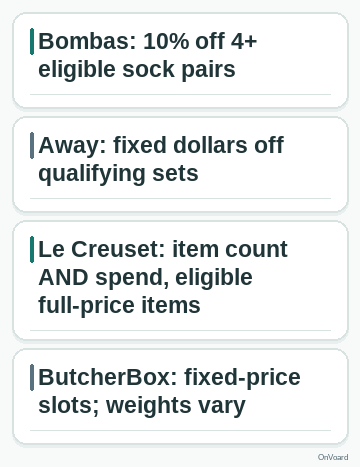
ButcherBox's Signature plans offer 6 selections for $179, 9 for $249 and 12 for $319. Listed weights are up to 21, 31 and 42 pounds respectively. Each item counts equally toward the box size; subscription intervals shown are 2, 4, 6 or 8 weeks.
The FAQ's published Medium example illustrates the unequal package weights:
2 10-ounce ribeyes and 1 2-pound baby back ribs selection
1 3.5-pound whole chicken and 3 1-pound chicken-breast packs
4 6-ounce flat iron steaks and 1 2-pound salmon pack
Those 6 selection groups total 13.25 pounds. It is a published example, not a guaranteed delivered mix. The 6 selections are neither 6 identical packs nor a promise of 21 pounds; add-ons are separate.
For the shopper, fixed-price slots make the total predictable while allowing a selection from the eligible menu. For the merchant, the important calculation moves into that menu. Package weights, landed costs and handling can differ even when each choice occupies the same number of slots.
For a concrete comparison, imagine a fictional pantry store, unrelated to ButcherBox. Its $60 box permits 6 selections, including repeats. Each selection is either a 2-pound oat pouch costing $4 landed or a 1-pound nut pouch costing $7 landed. Assume either completed box costs $12 to pack and ship, plus a $2.10 payment fee and $1.20 net returns/damage allowance. These are invented inputs, not merchant costs or provider rates.
Allowed six-slot basket | Contents weight | Goods cost | Order contribution |
|---|---|---|---|
6 oat pouches | 12 lb | $24 | $20.70 |
6 nut pouches | 6 lb | $42 | $2.70 |
Both combinations satisfy this fictional menu and earn $60, but the lighter one leaves $18 less contribution. For example, $60 − $42 − $12 − $2.10 − $1.20 = $2.70 before acquisition costs and overhead. Actual packaging or shipping differences would change the comparison. ButcherBox's public offer does not reveal its costs or establish these fictional combinations.
A slot model needs explicit package descriptions, repeat-selection rules and treatment of premium choices. The fictional notebook model below shows the cost risk without assigning invented economics to a real merchant.
Price the bundle against a realistic alternative
A bundle's individual-price total helps explain an offer, but it is not always the purchase the bundle replaces. Your customer may otherwise buy fewer items, the same items in 1 parcel, or replenishments over several orders.
The following 4 models are entirely fictional. All stores, products, prices and costs are illustrative, in USD. They are not the private economics of the merchants above. Customers pay no separate shipping charge, tax is excluded from revenue and fees, and no additional discounts apply.
Use 1 consistent calculation:
Order contribution = merchandise revenue after discounts − landed product costs − fulfillment and shipping − payment fee − net returns/damage allowance.
Product costs exclude the order labor, packaging and shipping listed separately. The invented payment fee is 3% of merchandise revenue plus $0.30 per order, not a provider quote. The allowance represents the expected additional net reduction after recoveries, without counting original costs twice. Contribution remains before acquisition spending, setup costs and fixed overhead; it is not net profit.
Fictional starter model: a larger order can still lose contribution
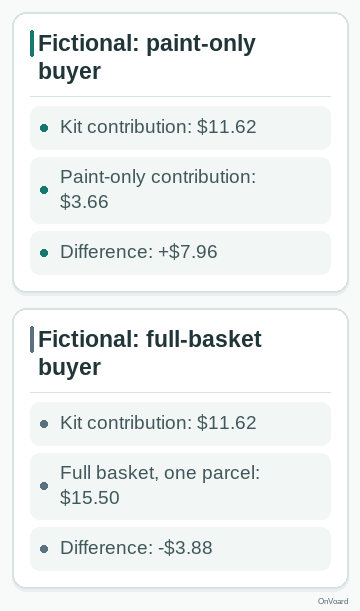
A watercolor store sells an $18 paint tin, $12 brush and $10 paper pad. Together they cost $40 individually; the starter kit is $36, a $4 or 10% merchandise saving.
The kit contributes $11.62. That is $7.96 more than a paint-tin-only order, but $3.88 less than selling all 3 products together at full price.
The kit's landed goods cost is $14: $7 for paint, $4 for the brush and $3 for paper. Fulfillment is $8, comprising $2 labor, $1 packaging and $5 shipping. The fee is $1.38 and the allowance is $1.
$36 − $14 − $8 − $1.38 − $1 = $11.62.
Now retain the costs appropriate to each alternative. The full basket contains the same 3 products at individual prices, shipped in 1 parcel:
Amount | Paint only | Kit | Full basket |
|---|---|---|---|
Revenue | $18 | $36 | $40 |
Goods | $7 | $14 | $14 |
Fulfillment | $6 | $8 | $8 |
Payment fee | $0.84 | $1.38 | $1.50 |
Allowance | $0.50 | $1 | $1 |
Contribution | $3.66 | $11.62 | $15.50 |
The paint-only fulfillment assumption is $1.50 labor, $0.50 packaging and $4 shipping. The other 2 baskets share a parcel and handling assumption, so their contribution difference is the discount reduced by the change in payment fee.
Trial the kit for beginners who need help assembling the essentials. If existing customers already buy all 3 products together, test whether the convenience alone can support the offer without a discount. The sale of a kit cannot tell you which alternative would have happened; that needs a comparison group or credible purchase history.
Fictional multipack model: count the parcels being replaced
A soap store sells 1 familiar 100 g bar for $12 or 3 identical bars for $32. The multipack saves $4 against a $36 individual-price total, approximately 11.1%.
The multipack contributes $13.24. It beats 3 separate single-bar orders by $4.12 under these assumptions, but trails 3 full-price bars in 1 parcel by $3.88.
The 3 bars cost $9.60. Multipack fulfillment is $2 labor, $0.80 packaging and $4.50 shipping, totaling $7.30. The $32 payment generates a $1.26 fee, and the allowance is $0.60:
$32 − $9.60 − $7.30 − $1.26 − $0.60 = $13.24.
A single-bar order has $3.20 goods, $4.90 fulfillment, a $0.66 fee and a $0.20 allowance, leaving $3.04. Its fulfillment comprises $1 labor, $0.40 packaging and $3.50 shipping. Those 3 orders contribute $9.12 in total.
The 3 bars at full price in 1 order instead contribute $17.12: $36 − $9.60 − $7.30 − $1.38 − $0.60. No parcels disappear when this is the actual alternative; the customer simply gets a lower price.
A replenishment multipack is worth testing for a product customers already use and can store. Observe a long enough period to see the next purchase. An initial order increase may pull demand forward, leaving fewer orders later. Do not credit avoided future shipments to every pack sale just because the arithmetic makes that version look attractive.
Fictional gift model: price the preparation explicitly
A tea gift contains a $30 teapot, a $24 pair of cups and a $14 tea tin. The products total $68 individually. A prepared version costs $78 and adds a presentation box, message card and tasting guide that are not sold separately.
The $10 premium adds only $2.70 in contribution. It pays for additional preparation as well as the product selection, so there is no merchandise-saving claim.
Goods cost $24: $12 for the teapot, $8 for the cups and $4 for tea. Gift fulfillment totals $16.50 from $3.50 assembly and picking, $6 packaging and printed materials, and $7 shipping. With a $2.64 fee and $2 allowance:
$78 − $24 − $16.50 − $2.64 − $2 = $32.86.
The unboxed $68 basket contributes $30.16, using the same $24 goods, $10 fulfillment, a $2.34 fee and a $1.50 allowance. Its fulfillment is $2.50 labor, $1.50 packaging and $6 shipping.
The gift's additional work and materials absorb most of the premium. If assembly costs another $3 beyond the estimate, its contribution falls to $29.86, below the unboxed basket. Measure a finished parcel and time the actual packing process before choosing the price.
You can test whether customers value the finished presentation without inventing a retail value for the box or calling the materials free. Keep the extra service clear enough that the customer understands why the prepared set costs more than the loose products.
Fictional selection model: test the expensive allowed combination
A stationery store lets customers choose 3 pocket notebooks, including repeats. Standard notebooks sell for $12 and cost $3.50 each. Premium-cover versions sell for $16 and cost $7 each.
A flat “any 3 for $30” rule contributes $9.70 on 3 standard notebooks but loses $0.80 on 3 premium notebooks. Both baskets have the same $8 fulfillment: $2.50 labor, $0.75 packaging and $4.75 shipping. Each also carries a $0.60 allowance and, at $30, a $1.20 fee.
For the expensive choice, the calculation is $30 − $21 − $8 − $1.20 − $0.60 = −$0.80.
A pricing candidate is $30 for 3 standard notebooks, plus $4 for each premium selection. With the same parcel and allowance assumptions, every permitted premium count can be checked:
Premium notebooks selected | Bundle price | Goods cost | Payment fee | Contribution |
|---|---|---|---|---|
0 | $30 | $10.50 | $1.20 | $9.70 |
1 | $34 | $14 | $1.32 | $10.08 |
2 | $38 | $17.50 | $1.44 | $10.46 |
3 | $42 | $21 | $1.56 | $10.84 |
Each upgrade adds $4 revenue, $3.50 goods cost and $0.12 in fees, leaving $0.38 extra contribution. Every selection saves $6 against the same notebooks bought individually, but the percentage saving varies: 16.7% for all standard, 12.5% for all premium.
Reject the flat-price version if premium repeats remain eligible and losing contribution is unacceptable. The surcharge version is only a candidate until its contribution meets your own requirement. If a choice changes packaging, shipping or handling, recalculate that combination too. A favorable average basket cannot make an allowed loss-making basket disappear.
Turn the chosen example into a sellable offer
Write a short offer card before configuring the bundle. It should capture the decisions that can otherwise become disconnected across the product page, checkout and packing process:
Customer and task: who needs this combination, and what they can do with it.
Contents and choices: exact products, quantities, sizes, allowed substitutions and repeat selections.
Price and comparison: the payable total, any surcharges, the matching individual-price basis and the smaller basket you expect to replace.
Delivery and later obligations: included presentation, shipping promises, redemption, prepaid deliveries and renewal terms.
Cost boundary: landed goods, labor, packaging, shipping, fees, expected returns or damage, and the contribution required for the offer.
Avoid using the sum of unrelated variants or a subscription price to advertise savings on a one-time bundle. Keep merchant-stated value separate from a verified current individual-price total. When a component price changes, recheck the displayed comparison as well as the bundle's own selling price.
The OnVoard markup calculator can help check gross margin, markup, target price and discount arithmetic from product cost. It does not calculate the complete contribution model above automatically. Add your order-level costs separately before judging whether the proposed price is workable.
Then pack the offer once and test its edge cases. Pick the largest physical combination, the most expensive allowed selection and a configuration with a component unavailable. Confirm that the order describes what the warehouse must send and that shared component stock cannot promise the same units twice.
Returns need an explicit rule before launch. Decide what happens when a customer keeps part of a discounted set, returns a damaged component or has already redeemed a digital entitlement. Apply the policy your sales channel can actually support, and show the relevant terms before purchase. The bundles guide covers component stock, order representation and return allocation in more detail.
Keep the initial experiment narrow. Changing quantities, price, packaging and delivery at once makes the result harder to diagnose. If the problem is choosing among promotion mechanics, use the sales promotion examples. If the offer is settled and the remaining question is where to recommend it, use the product recommendation guide.
Test one offer before expanding the range
Choose the comparison and decision rule before the first sale. Specify the uncertain outcome: useful extra products purchased, replenishment orders consolidated, or a gift premium that covers the preparation.
Where possible, compare similar eligible shoppers with and without the bundle offer while holding the surrounding promotion and traffic conditions steady. A simple before-and-after result can be distorted by seasonality, acquisition mix or an unrelated sale. When a controlled comparison is impractical, record those differences and avoid treating the result as proof that the bundle caused the change.
Review these measures together:
Orders and conversion among the shoppers eligible to see the offer
Average order value and units, including standalone purchases displaced
Total contribution and contribution per eligible visitor after actual variable costs
Returns, damage, support burden and recurring or redemption obligations
Repeat purchasing over a period appropriate to the quantity sold
Set the observation window around the question. A gift-packing test needs enough completed orders to expose assembly and shipping costs. A 3-unit replenishment pack needs time for customers to use the extra quantity before judging repeat purchasing. A prepaid delivery offer remains an obligation after the initial revenue arrives.
Keep the bundle when it serves the intended customer and clears the economic requirement against a credible alternative. If shoppers value the composition but the discount absorbs too much contribution, change the price before adding more products. If one constituent is repeatedly unwanted, repair the selection.