
On this page
A loyalty program looks simple from the outside: join, earn, redeem. The part worth studying is underneath: what earns value, what customers can redeem, whether status is separate from spendable rewards, and how much margin the program gives back. Each of the 18 programs below is broken down that way, with the part a smaller store could realistically borrow.
Program rules change often. The rates, fees and thresholds quoted below are the U.S. terms as published when we checked on September 18, 2026. Where we could not confirm a current number on the official page, we describe how the program works without it.
What to look for in each program
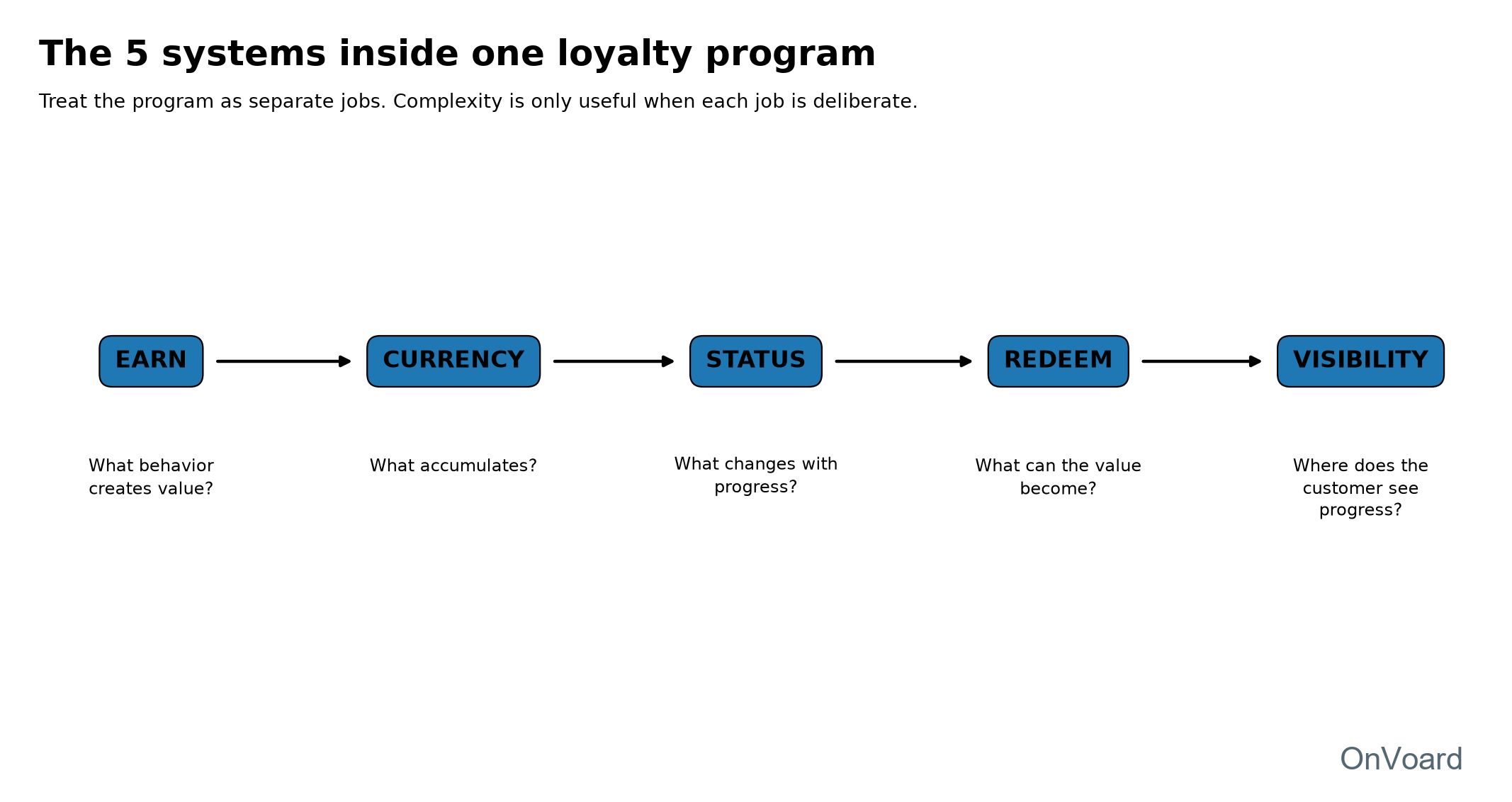
Every program below combines 5 systems that can be designed independently. Looking at them separately is what lets you borrow one idea without copying a whole program:
Earning: what behavior creates value. Usually spend, but IKEA rewards planning, adidas can reward workouts and reviews, and LEGO can reward registering sets. Every earning rule is something you pay for: points for reviews subsidize reviews, points for referrals subsidize acquisition.
Currency: what the customer accumulates, whether points, Stars, stamps, store credit or nothing at all. Check whether its value is easy to understand, whether it expires, whether it reverses after a return and whether it grows as the balance grows.
Status: whether long-term progress is separate from spendable value. A tier should change something the customer feels, such as faster earning, free shipping, early access or better service.
Redemption: what the customer can turn value into: a discount, a product, access, a service, or in paid programs, benefits that are always on.
Visibility: where the balance shows up and when the program reminds the customer. "Your $10 reward is ready" changes a decision. A monthly loyalty newsletter rarely does.
For each example, notice which system is doing the heavy lifting and what behavior it is meant to change. That is usually the piece worth borrowing.
Points that behave like money
Points are easiest to understand when the customer can mentally convert them into something real. The catch is that not every program wants points to behave the same way. Some make the exchange rate flat. Some make larger balances more valuable. Some automatically turn points into a reward before the customer has to think about redemption.
1. Ulta Beauty Rewards makes saving points part of the game
Ulta's base program is easy to enter: membership is free and ordinary members earn 1 point for every $1 of qualifying spend. Platinum and Diamond status increase the earn rate to 1.25 and 1.5 points per $1 respectively.
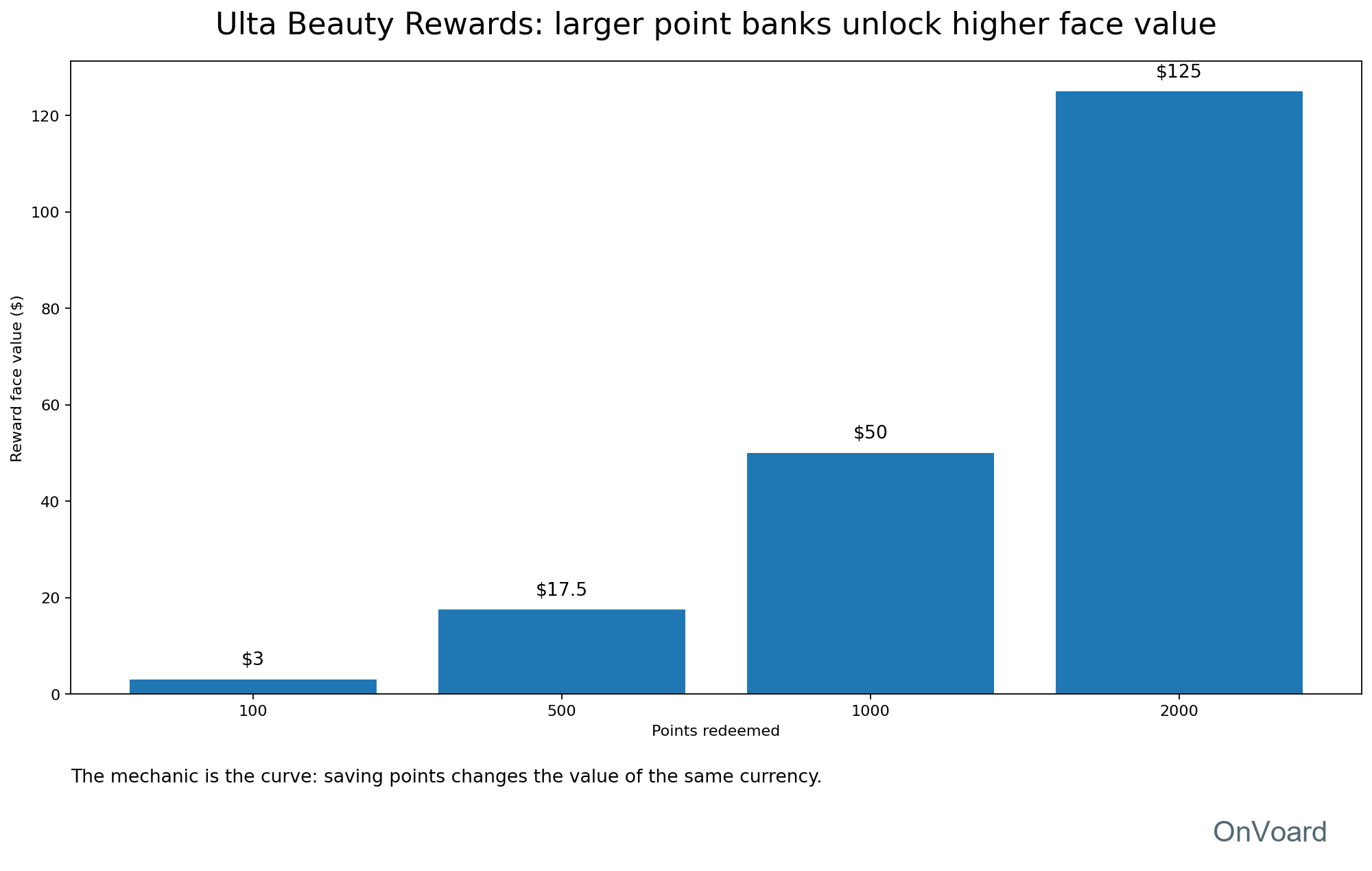
The interesting part is redemption. Ulta does not use a flat value per point. Its current redemption table gives $3 off for 100 points, compared with $17.50 off for 500, $50 off for 1,000 and $125 off for 2,000.
That changes customer behavior. At the base earn rate, 100 points earned from roughly $100 of qualifying spend can be worth $3, compared with $125 for 2,000 points. In simple face-value terms, the implied return is about 6.25% at the 2,000-point step, up from about 3% at the small redemption step.
So Ulta is doing 2 things at once. It gives customers a usable reward early, but it also makes patience valuable. The customer has a reason to bank points instead of burning them as soon as possible.
We would only borrow this if the balance is extremely easy to see. Nonlinear redemption is powerful, but it creates cognitive load: if customers need a help article to work out whether 700 points is worth saving, the program has turned a reward into accounting. You also have to support the curve forever, through returns, partial redemptions and customer-service disputes.
What to copy: make the customer-facing value of a larger balance visibly better if you want to encourage saving.
2. DSW VIP makes status immediately change the earning speed
DSW VIP uses one of the clearest tier designs in this list. A point is worth the same at every tier, and the higher tiers earn points faster, so the tiers differ only in how quickly value arrives.
That gives the customer a simple reason to care about status: the same purchase earns more at the next level.
The face-value math is easy to show a customer. Suppose 200 points make a $1 reward. A tier earning 5 points per $1 then returns 2.5% of spend, and a tier earning 10 points per $1 returns 5%.
This is a stronger tier design than a ladder where the only change is a new label and a once-a-year birthday perk. If you are going to ask a customer to chase status, the program should answer "what changes for me?" in one sentence.
A higher earn rate is still a real cost: doubling the rate doubles maximum face-value accrual for each qualifying order. Realized cost still depends on redemption, exclusions, returns and the cost of what is redeemed. Price it against gross margin and the behavior you expect the higher tier to change.
3. PetSmart Treats Rewards ties the currency to recurring behavior
PetSmart's Treats Rewards starts with a straightforward base rate: members earn 10 points per $1, and 1,000 points can be redeemed for $2 in savings, because the program values each point at a fifth of a cent. Bestie status, unlocked by annual spend, adds 2 points per $1, and VIPP adds 4.
At face value, that is about 2% back for the base member, compared with 2.4% for Bestie and 2.8% for VIPP before other offers.
But the program gets more interesting when you look beyond the basic points. PetSmart can reward services, personalized offers, charitable donations, profile completion and recurring Autoship spend. When we checked, a limited-time Autoship offer added 2,500 bonus points, worth $5, for every $100 of repeat Autoship spend, on top of the base and tier points.
PetSmart is not treating loyalty as a separate marketing campaign. It attaches the reward system to the purchase behavior that creates repeat orders naturally.
If your store sells replenishable products, a loyalty program that ignores subscriptions, replenishment or recurring purchase cadence is leaving the strongest behavior outside the system.
Stacked benefits can become expensive quickly. Base points, tier bonuses, subscription discounts and recurring-spend bonuses should be modeled together. The customer sees one attractive total. Your margin sees all of them.
4. The North Face XPLR Pass removes the redemption decision
The North Face's U.S. XPLR Pass takes a different route. Once a member's points reach the program's threshold, they convert into a reward on their own.
The automatic conversion is the design choice that matters: the customer never has to visit a catalog and decide whether to exchange points for store credit. The system makes that decision for them.
That is a good fit when the points are mainly a delayed discount. It reduces one source of breakage and makes the value feel closer to cash.
It is a worse fit if your goal is to create anticipation around a catalog of rare rewards, experiences or collectibles. Automatic conversion trades excitement for clarity.
The North Face also layers early access, limited products, member offers and selected experiences around the core reward. That gives the program emotional value without making the point conversion itself harder to understand.
If your points are basically store credit, ask whether the redemption step adds any value. Sometimes the best redemption experience is no redemption decision at all.
Give the same points more than one useful exit
A flat cash discount is easy, but it is not the only way to make a loyalty currency valuable. Sephora and LEGO show the other direction: let the same balance open several kinds of reward.
This works best when the non-cash rewards are genuinely desirable. A catalog full of unwanted products will not drive redemptions and can waste inventory cost.
5. Sephora Beauty Insider makes the reward choice part of the product
Beauty Insider gives members points on qualifying spend, and higher VIB and Rouge status is unlocked by annual spend.
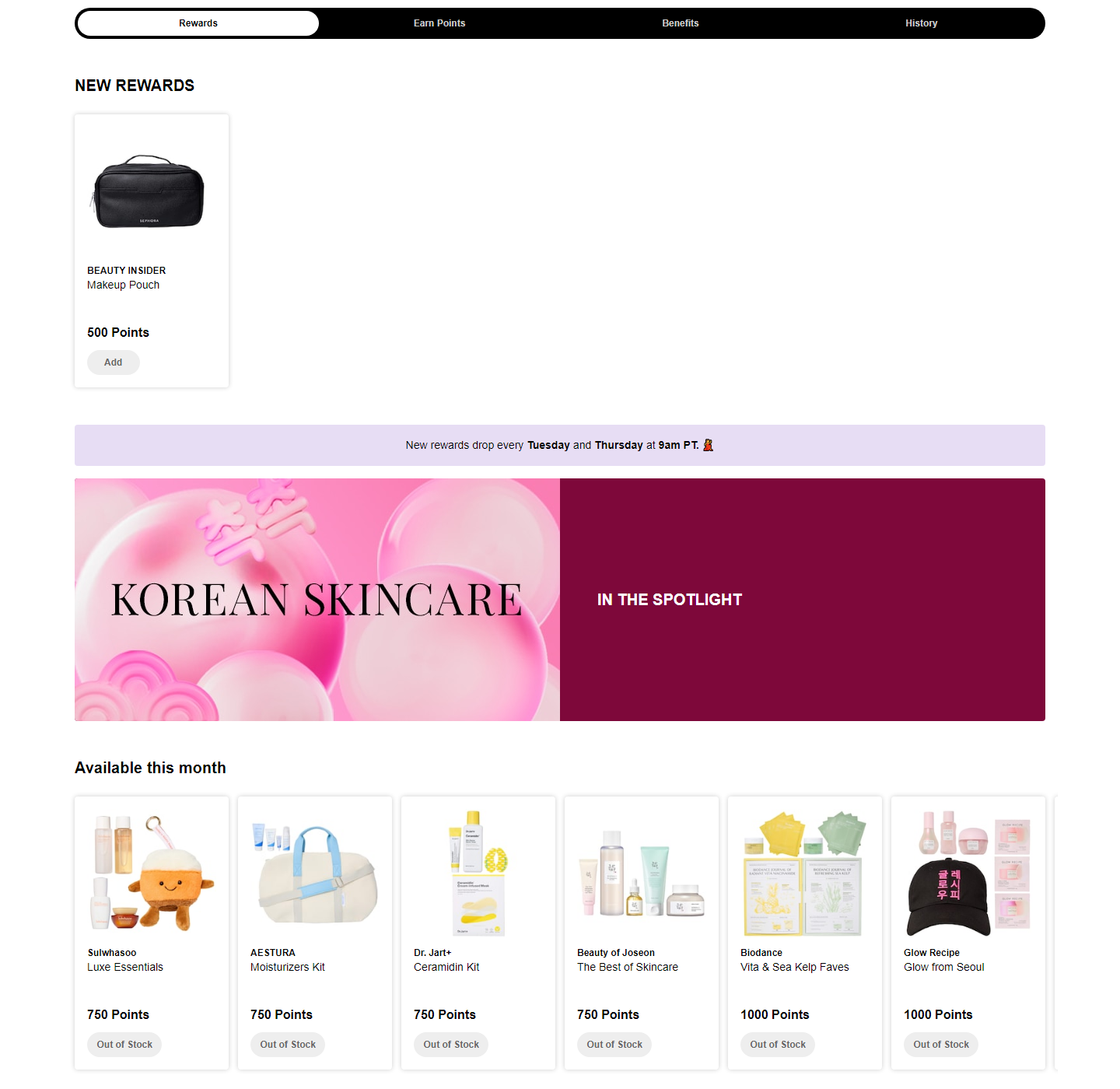
If Sephora stopped there, it would be a normal points-and-tier program. The Rewards Bazaar is what changes the feel. Points can go toward samples, products and experiences, while Beauty Insider Cash gives a more direct savings route at a fixed exchange.
That creates choice in the reward itself. One customer may want predictable cash value. Another may rather spend points on a limited product or experience that feels more special than the dollar amount.
That is useful for categories where sampling is valuable. A reward can introduce the customer to a new brand, size or product without making every redemption a margin-heavy cash discount.
There is a trade-off. A catalog creates inventory expectations. If the best rewards are constantly unavailable, scarcity stops feeling exclusive and starts feeling broken.
Offer 2 meaningful redemption modes only when they solve different customer desires. Cash-like value plus a genuinely interesting catalog is a coherent pair.
6. LEGO Insiders mixes economic value with fandom value
LEGO Insiders is one of the cleanest examples of a catalog that fits the brand. Members earn points on purchases and can turn them into a plain discount.
But LEGO does not force every point into that cash-equivalent path. Members can use points for discounts, exclusive rewards, experiences, member merchandise, digital downloads and gifts. They can also earn through some non-purchase activities, including registering sets.
That matters because the customer relationship is not only transactional. A serious LEGO customer may value access to a collectible or member-only item more than a small discount.
This is the point where many smaller brands overreach. They see a reward catalog and add branded stickers, desktop wallpapers and low-value merch that customers never asked for. LEGO's catalog works because the fandom already exists.
Use a catalog when your product has identity, collectability or community around it, and let points buy something the customer cannot get from a generic coupon.
Skip the rewards store the loyalty software offers if the catalog has no pull. Keep the currency simpler instead.
Tiers should change the relationship, not just the color of a status label
Tiers are expensive complexity. You now have qualification rules, status periods, downgrade behavior, customer-service edge cases and a new promise to maintain.
That complexity earns its keep only when the next level is materially different.
7. Starbucks Rewards stacks currency, status and gamification
Starbucks' U.S. Rewards terms, effective March 10, 2026, are worth studying because they do not ask one feature to do every job.
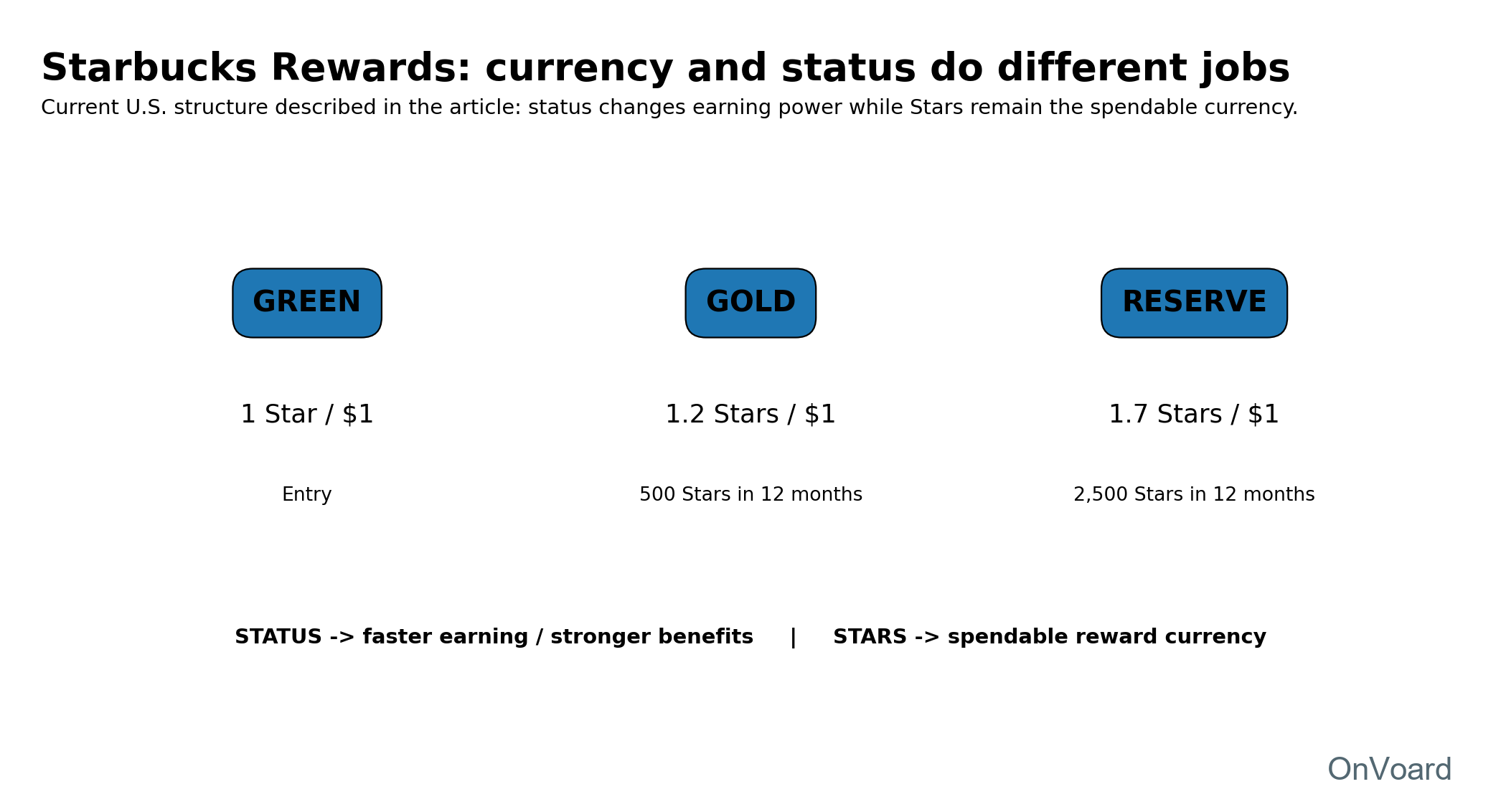
The program now has Green, Gold and Reserve levels. Green begins at enrollment. Gold requires 500 Stars in a 12-month period, while Reserve requires 2,500. The earning rate also changes by status: Green earns 1 Star per $1, Gold 1.2 and Reserve 1.7. Gold and Reserve add benefits beyond the faster earning.
Separately, Stars can be redeemed across different reward tiers. Starbucks also keeps personalized offers and games in the program.
That is 4 different loops:
currency gives a reason to come back;
status gives a longer-term target;
earning acceleration makes status economically meaningful;
bonus events and games create short-term reasons to act now.
This is exactly why a small store should not copy the whole thing. Start with the loop you actually need.
If customers already buy weekly, a visible currency may be enough. If your best customers spend dramatically more than the median customer, status may be useful. If the program is mature and participation has gone flat, short bonus events can add novelty.
What to copy: give each layer one job. Currency, status and games should not all exist just because the software supports them.
What to watch: complexity compounds. A member should still be able to answer 3 questions instantly: what do I have, what can I get, and what gets me closer?
8. adidas adiClub separates status from spendable value
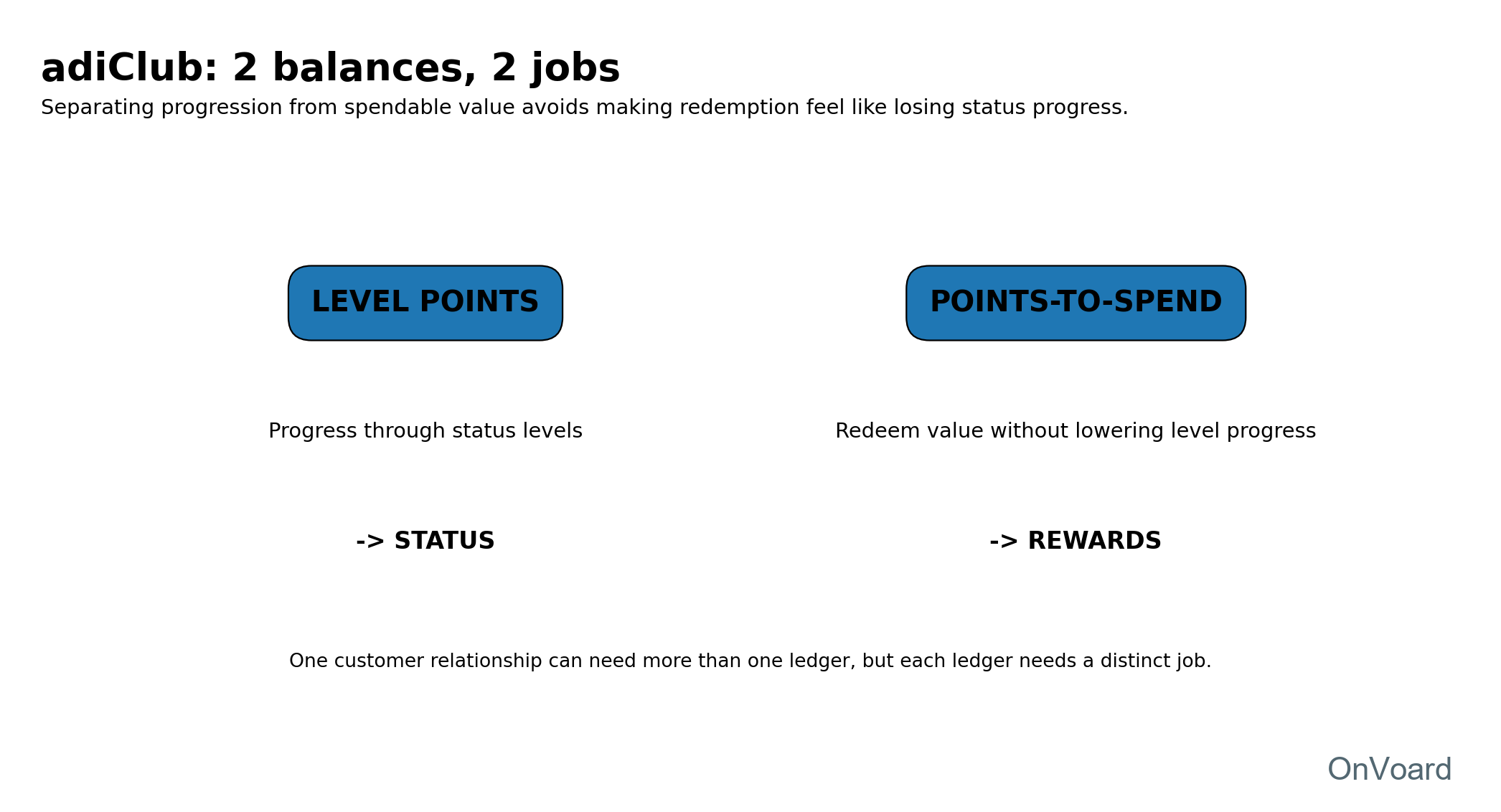
adiClub solves a common tier problem with 2 balances.
Members earn points from purchases and other actions such as completing a profile, tracking workouts, reviewing products and sharing a look. But adidas distinguishes Level Points from Points-to-Spend.
Level Points determine status. Points-to-Spend can be redeemed for products, events, vouchers, draws and partner offers. Redeeming the spendable balance does not lower the member's level progress.
That separation is cleaner than using one balance for both jobs.
Imagine a customer is 50 points away from your VIP tier but also wants to redeem a $10 reward. If redemption knocks them backward, you have created a tension between enjoying the program and progressing in it. adidas avoids that by letting status and redemption coexist.
This is especially useful if the program rewards non-purchase actions. The merchant can decide which actions should contribute to status and which should only generate spendable value.
What to copy: if you want both a loyalty currency and a status ladder, seriously consider separate ledgers. "Spendable" and "qualifying" points are different concepts.
What to watch: 2 balances demand excellent UI. If the customer sees 2 numbers without understanding the difference, the cleaner backend becomes a messier front end.
9. Princess Polly makes progression visible and aspirational
Princess Polly uses a more traditional ladder of named levels. Members move up by earning points on purchases and on selected actions such as referrals.
Each level adds stronger rewards, and the upper levels add access and service perks rather than only bigger discounts.
What works is that progression is visible and the higher levels have an identity.
For fashion and drop-driven stores, access can be a stronger tier benefit than another 5% coupon. Early access protects margin better than a deeper discount while still making status feel different.
Use tiers to change access, convenience or earning speed, so the higher level has something members can feel before the annual birthday email arrives.
Tier-entry discounts that keep getting larger are simple, but they can train your best customers to expect the deepest discount. Access and service perks can be cheaper and more distinctive.
10. H&M Membership combines points, vouchers and tier benefits
H&M's U.S. terms describe points, vouchers, 2 membership tiers, and exclusive offers, services and events. It is a useful example of combining a currency with member benefits without relying on one benefit type.
For a merchant combining points and tiers, show which balance funds a voucher and which progress changes status. Use offers, services or events only when the business can deliver them consistently.
Reward the work customers do before they buy
Most programs start earning at checkout. That is sensible, but not mandatory.
For considered purchases, the customer may do meaningful work long before the order: saving products, using a planner, attending a consultation, configuring something, creating a wishlist or learning how a product fits.
11. IKEA Family rewards planning behavior, not only spend
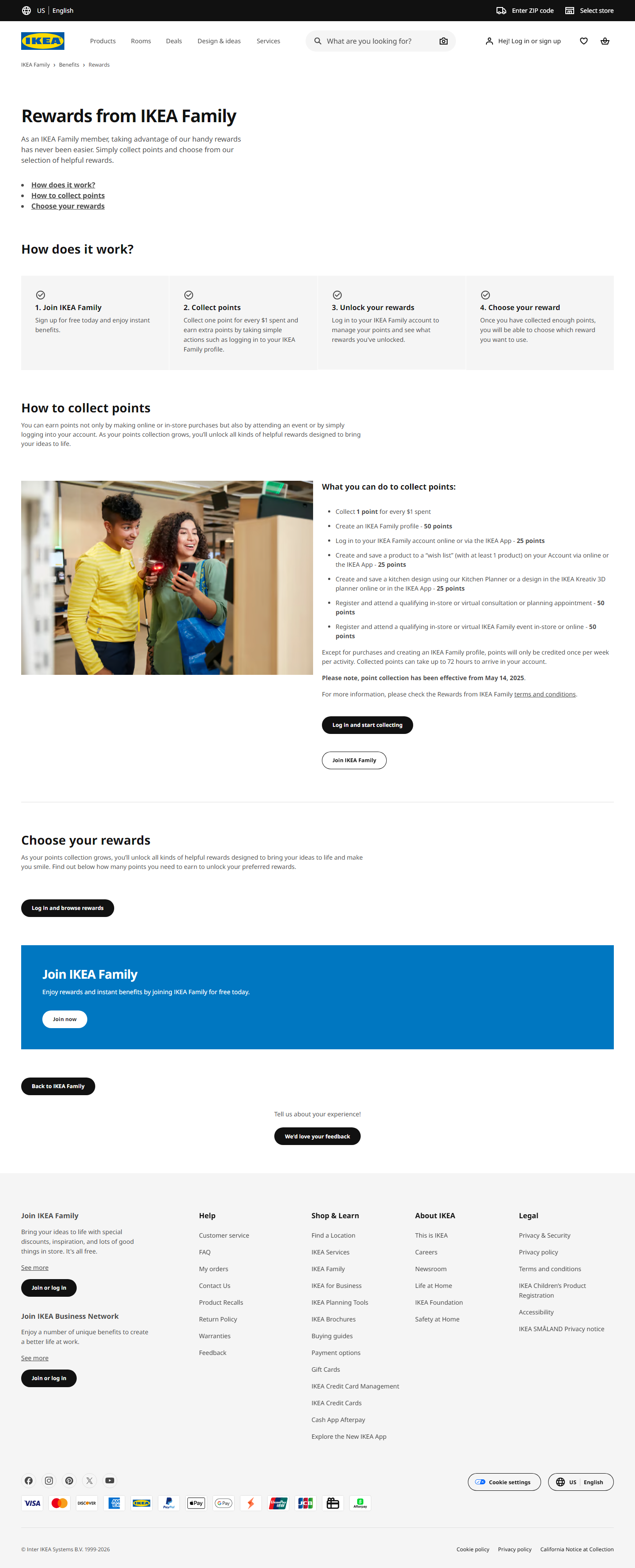
IKEA Family in the U.S. awards 1 point per $1 spent, plus points for selected high-intent activities: creating a profile, logging in, saving a wish list, saving a kitchen or 3D room design, and attending a qualifying planning appointment or event. Apart from purchases and the profile, each activity earns at most once a week.
That is much more interesting than "follow us on Instagram for 25 points."
A saved kitchen plan is high-intent behavior. A consultation can move a complicated purchase forward. A wishlist gives the customer a reason to return to the account. These actions can reduce purchase friction even when they do not create revenue immediately.
For stores with expensive, configurable or research-heavy products, this opens a different loyalty design: reward progress toward purchase, not only the final transaction.
A furniture store could reward room-plan completion. A beauty store could reward finishing a skin profile. A specialty food store could reward a preference quiz only if the result changes recommendations or replenishment. The action should make the next purchase easier.
Identify the 1 or 2 pre-purchase actions that go with genuine buying intent and make the account more useful, and skip low-signal clicks: a loyalty balance should not become a bounty board for vanity engagement.
Loyalty can work without points
Some businesses do not need another currency. If customers already understand the product and the brand can deliver meaningful access or service, the account itself can be the benefit.
12. Nike Membership turns the account into an access layer
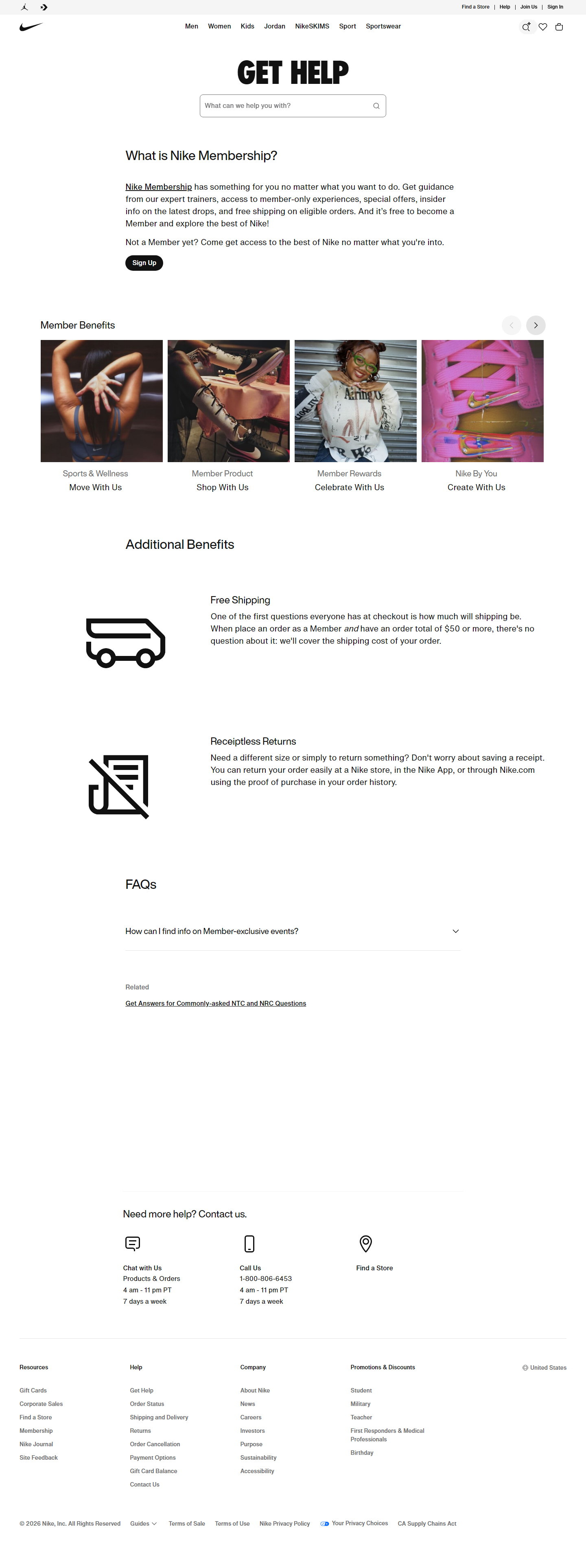
Nike Membership is free and does not lead with a point exchange rate. The benefits are built around member product, Nike By You customization, member rewards, the SNKRS app, sport and wellness content, free shipping on orders of $50 or more, and receiptless returns.
That makes the membership useful across several parts of the Nike ecosystem. A customer can value the account even when there is no point balance waiting to be redeemed.
This model fits brands with strong releases, content, tools or community. Being signed in gives the customer access to more of the brand.
For a smaller merchant, the copyable version is much narrower. You do not need an app ecosystem. You might need one member-only drop, one early-access window and one useful saved preference.
The thing to work out is what gets better because the customer is known. Nike can connect the same identity across product access, customization, content and experiences. A smaller brand might connect fit history to early access, saved sizing to faster checkout, or a member profile to a care service. Those benefits are cheap only when the underlying data or service already exists, which is why access programs should grow out of real product operations rather than a list of invented perks.
If discounts would cheapen the product, ask what access or utility only a known customer can receive, and make sure the thing behind the gate is worth accessing.
13. lululemon Membership makes basic service better for signed-in customers
lululemon Membership is also free, and its benefits lean on service: receipt-free returns, free hemming and early access to product drops sit alongside member events.
Notice how practical several of those are. Receipt-free returns and hemming are not glamorous loyalty rewards. They remove friction from owning the product.
A loyalty program can improve the after-purchase experience instead of discounting the next order. For categories where fit, setup, repair, refill, warranty or care matters, service benefits can be more defensible than points.
This is also easier to keep honest. A 10% discount has a visible cost every time it is used. A useful service may cost less than its perceived value, especially when the business already performs the service. Hemming is a strong example because it improves the product the customer already bought. The member gets more utility from the purchase without being trained to wait for a coupon.
For a smaller store, think in the same direction: free fit adjustments, priority replacement parts, a refill reminder with saved preferences, or easier exchanges for known customers. The loyalty benefit should remove a friction that actually exists in the category.
List the post-purchase frictions your known customers hit repeatedly. A member benefit that removes one of them can create loyalty without creating a permanent discount budget.
Paid loyalty has to pass a harder value test
Free points can be mediocre and still attract signups because the cost of joining is almost zero. Paid membership does not have that luxury.
The customer asks a brutally simple question: will I get the fee back?
That is why the best paid programs make the value concrete quickly.
14. REI Co-op uses a one-time fee to create a lifetime relationship
REI's model is unusual because U.S. membership is a one-time fee rather than a yearly subscription. Members can earn an annual Co-op Member Reward on eligible full-price purchases, a customer-facing reward rather than a guaranteed rate, plus benefits around used gear, rentals, shop services, classes and other co-op experiences.
The one-time fee changes the psychology. REI is not asking the customer to re-justify the membership every year. Once someone joins, the program can behave more like a durable customer identity.
It also changes the merchant's obligation. A yearly fee can fund yearly benefits directly. A lifetime fee cannot. The program therefore needs benefits whose ongoing cost is supported by the customer's future purchases, service usage, or the broader economics of the membership relationship. That makes a one-time membership a much more serious promise than a one-time signup coupon.
That fits the co-op structure and the outdoor category, where services, gear lifecycle and community can matter alongside product transactions. It would be a poor fit for a low-frequency store that has no ongoing service, access or repeat-purchase reason after the first order.
A normal ecommerce store should not copy the legal or cooperative structure. But the economic idea is useful: sometimes a lifetime or one-time paid tier makes more sense than recurring billing if the benefit costs are controllable and the goal is to deepen a long relationship.
Paid access should include a bundle with recurring usefulness, not one welcome coupon.
15. Wayfair Rewards makes the break-even calculation easy
Wayfair launched Wayfair Rewards in 2024 as a $29-a-year membership with 5% back in rewards on merchandise, plus free shipping, member-only sales, early access to major sales events and a priority support line.
For that paid membership, the face-value break-even from rewards alone is easy to calculate:
Break-even is $580 of qualifying annual spend, because $29 annual fee / 5% reward rate = $580.
That is before assigning any value to shipping or other perks.
This is what we want from a paid program. The customer should be able to do the math without a spreadsheet. If they expect to spend much more than the break-even amount, the fee starts to feel rational. If they expect to spend much less, the merchant needs another strong benefit.
Wayfair also keeps the reward in its own ecosystem, which encourages a future order rather than paying cash out of the business.
What to copy: show the membership's value in the units customers already understand. Cash back, shipping avoided, services included or a concrete discount are easier to trust than vague "VIP value."
What to watch: break-even for the customer is not break-even for the merchant. Reward cost, shipping cost, incremental orders and cannibalized full-price behavior still have to be modeled separately.
16. My Best Buy Plus and Total sell 2 different jobs
Best Buy's current paid memberships are a good example of tiers that are not simply "more discount."
My Best Buy Plus is the lower-priced tier, built around savings and convenience: member prices, rewards on eligible purchases, free shipping and a longer return window.
My Best Buy Total costs more and adds protection plans and support services on top of the Plus-style benefits.
Those tiers solve different problems. Plus is mostly about savings, access and convenience. Total is about protecting and supporting expensive technology purchases.
That is better than a paid ladder where Bronze gets 5% off and Gold gets 10% off. The customer can choose based on the job they need the membership to do. The higher fee is not justified by a prettier tier name. It is justified by a different cost structure and a different customer anxiety.
This is a useful pattern for merchants selling products with installation, warranty, maintenance or support needs. A higher membership tier can include service that would otherwise be bought separately. But that only works if the service is genuinely valued and the business knows its delivery cost. Paid loyalty turns vague perks into a contractual-feeling expectation very quickly.
If you create paid tiers, vary the benefit category, not only the discount depth. Service, warranty, setup, support or priority can justify a higher fee without turning every purchase into a larger subsidy.
17. Barnes & Noble combines a free earn layer with a paid upgrade
Barnes & Noble has 2 loyalty paths that sit together cleanly.
The free Rewards Membership earns 1 stamp for each complete $10 of eligible items in a single order, and 10 stamps become a $5 reward. That is up to 5% back, but partial $10 steps do not carry over between orders: 10 purchases of $19 earn 10 stamps, which is $5 on $190 of spend, or about 2.6%.
Premium Membership costs $39.99 per year and includes the free Rewards benefits plus a 10% everyday discount on eligible purchases, free standard shipping, café perks, an annual tote and other benefits.
This is a useful hybrid architecture. The merchant does not force a customer to pay before experiencing the rewards system. Frequent customers can then upgrade into a membership whose value is easier to justify.
The simplified discount-only break-even on the Premium fee is $399.90 of fully eligible annual spend at a 10% discount, because $39.99 divided by 10% is $399.90, before counting shipping or other perks. Real economics are messier, but the customer-facing logic is obvious.
A free loyalty layer can feed a paid upgrade. That is less risky than asking every new customer to buy a membership before they have a habit with the store.
18. Amazon Prime shows the extreme version of utility loyalty
Prime is often called a loyalty program even though it is not built on points. In the U.S. it is a paid annual or monthly membership. The bundle includes fast shipping across a huge catalog, exclusive deal events and other benefits spanning entertainment, grocery, healthcare and more.
A smaller store cannot win by bundling 20 benefits.
Prime shows what happens when membership reduces friction so consistently that the merchant becomes a default destination. Shipping is faster. Deals are member-specific. Entertainment keeps the account relevant between purchases. The customer has already paid, so using the ecosystem again feels easier.
For a smaller ecommerce business, the equivalent might be much simpler: free shipping, priority support and early product access for a category that customers buy repeatedly.
Paid loyalty should remove a recurring pain often enough that the customer remembers the membership before the next purchase. 10 weak perks do not add up to one strong reason to renew.
8 ideas worth borrowing from these programs
Across the 18 programs, the same 8 ideas keep doing the work. Each one suits some stores and hurts others.
Flat points-to-value conversion. A predictable currency at a stable rate. It is the easiest model to explain and usually the right start for a small store, as long as a typical repeat customer reaches the first reward within the orders they already place in a year.
Bank-for-more redemption (Ulta). Larger balances are worth more, so customers have a reason to save. Use it only if the rising value is easy to see, and skip it if customers already struggle to understand the currency.
Reward catalogs (Sephora, LEGO). Points buy samples, products, collectibles or experiences that mean more to the customer than they cost you, ideally things members cannot simply buy at the same price.
Faster earning at higher tiers (DSW, Starbucks, Ulta, PetSmart). Customers feel it on every qualifying purchase, which makes it one of the clearest VIP benefits. It is also one of the easiest ways to overspend on your best customers, so price the rate before launch.
Separate spendable points from status points (adidas). Customers can redeem without losing tier progress. Worth it when status is a long-term achievement but rewards should be used often.
Rewarding actions beyond purchase (IKEA, adidas). Pay only for actions that improve purchase readiness, give you useful customer data, create credible advocacy or deepen product use. If an action does none of those, do not pay for it with points.
Access and service instead of currency (Nike, lululemon). Drops, saved preferences, alterations or easier returns can matter more than a balance, and they usually protect margin better than cash rewards.
Paid utility (REI, Wayfair, Best Buy, Barnes & Noble, Amazon). The customer has to know why the fee is worth paying and renewing. If the answer depends on a long list of small perks, the program is not ready to charge.
Run the reward math before you touch the design
Loyalty software makes it easy to add points, tiers and rewards. That is exactly why merchants can launch bad economics quickly.
We would calculate 4 things before designing the page.
Face-value reward rate
Start with the simple version:
Face-value reward rate = reward value earned / eligible spend.
From the examples above: PetSmart's base rate works out to about 2%, Ulta's runs from about 3% to 6.25% depending on when points are redeemed, and Barnes & Noble's stamps return up to 5%.
These are customer-facing value calculations, not merchant profitability calculations. They ignore redemption behavior, exclusions, returns, gross margin, breakage, incremental purchasing and the fact that some rewards may cost you less than face value.
Still, this first calculation catches ridiculous setups fast.
Time to first useful reward
A 10% reward rate is meaningless if a normal customer needs 18 months to reach the first threshold.
Use your actual order data. Find how many orders a typical repeat customer places in a year (the typical repeat customer, not your best one), then divide the first reward threshold by what a typical order earns. If reaching the first reward takes more orders than that customer places in a year, the points are unlikely to change what they do.
If the answer is too many, you have 3 levers:
increase earning;
lower the first threshold;
add a smaller early reward while keeping a larger aspirational reward later.
Ulta does the third. A member can redeem relatively early, but saving creates more value.
Paid-membership break-even
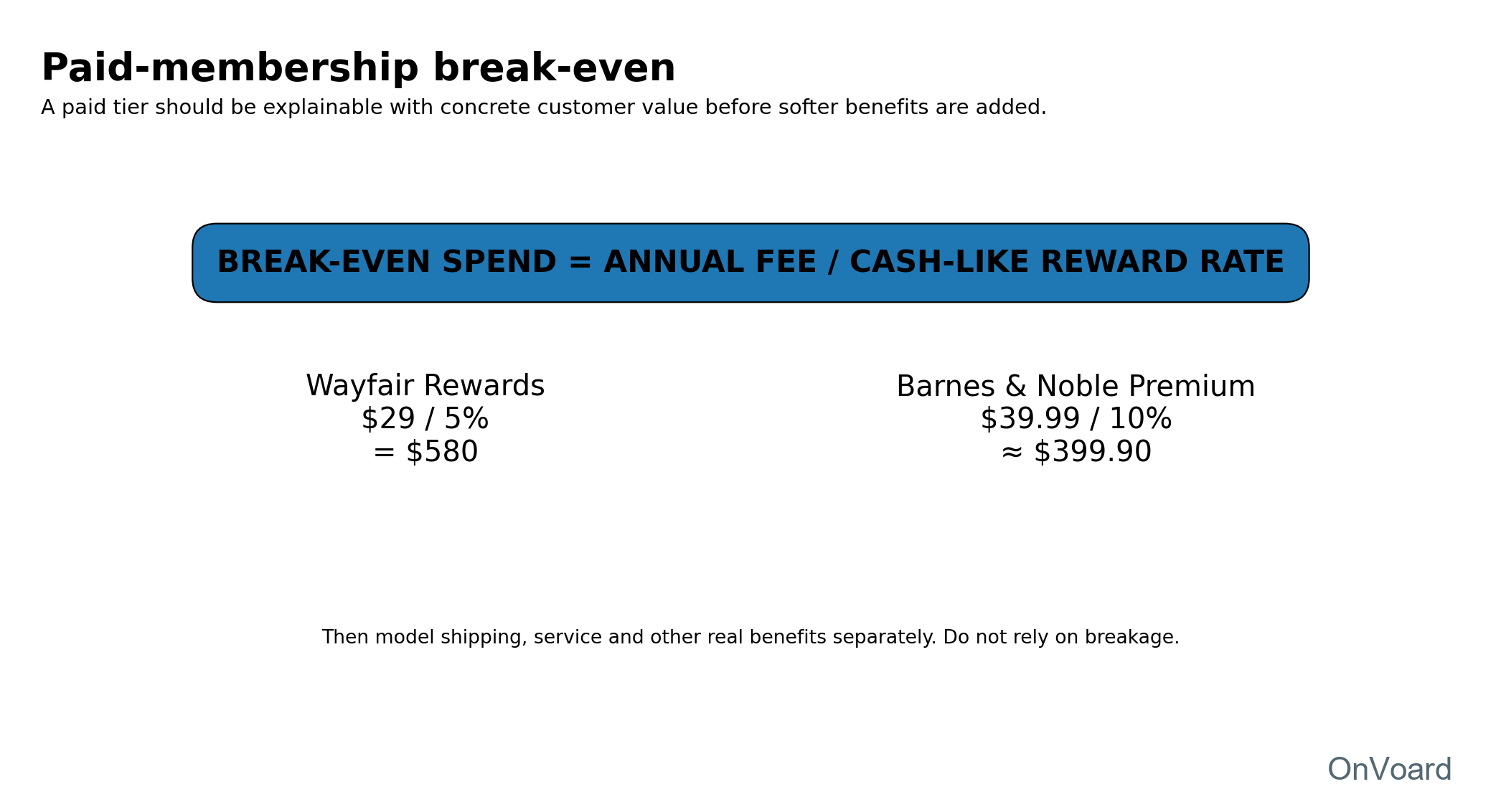
The simplest customer-facing version is:
Break-even spend = annual fee / cash-like reward rate.
That is where the figures above come from: $580 for Wayfair's paid membership and $399.90 for Barnes & Noble Premium, before counting shipping or other benefits.
Do not stop there. If free shipping is the main value, model shipping. If service is the main value, model service usage. If the fee exists mainly to increase commitment, that is much harder to promise honestly and should not be the public value proposition.
What a reward really costs you
The merchant-side question is different from the customer's reward rate.
A $10 reward does not always cost you $10. A free product may have a lower cost of goods than its retail price. Free shipping may cost more than expected for certain orders. A percentage discount hits high-value carts harder than low-value ones.
We would model the worst reasonable redemption, not only the average one: compare the reward rate with your contribution margin after fulfillment on your most expensive basket as well as the average one. The program should survive a customer using it exactly as advertised. If it does not leave margin you are willing to keep, move value into access, service or rewards that cost less than their face value.
Do not make breakage part of the business case. Unredeemed points may reduce realized cost, but if the program only works because customers fail to use it, the incentive is fighting the product promise.
Choose what fits your store
Start from the behavior you need to change, not from the brand whose program looks best. How often customers buy, what your margin can support and what friction stops the next order decide the starting point.
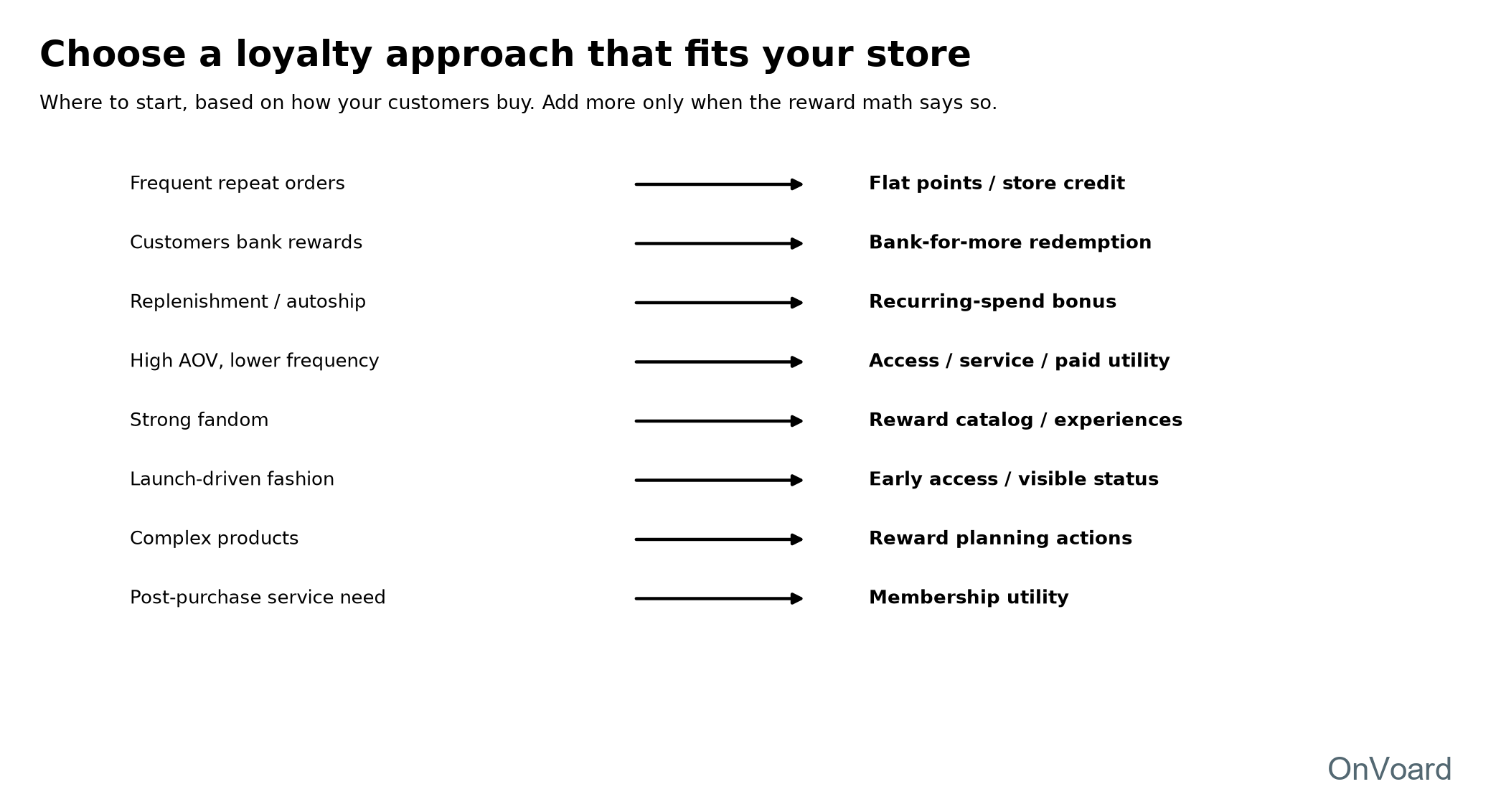
If your store has | Start with | Add later | Avoid |
|---|---|---|---|
Frequent, lower-value repeat orders | Flat points or store credit | Bonus events | Too many tiers |
Customers already save points for bigger orders | Bank-for-more redemption | VIP earn multiplier | Opaque point value |
High-repeat replenishment or Autoship | Base points + recurring-spend bonus | Tier acceleration | Stacking too many subsidies |
High AOV, lower purchase frequency | Access, service or paid utility | Lifetime status | Tiny points that take forever to matter |
Strong fandom or collectible products | Reward catalog | Experiences | Low-value branded filler |
Fashion, launches or scarce drops | Early access + visible status | Points | Deepening discounts at every tier |
Complex or configurable products | Reward planning actions | Service benefits | Paying for low-intent clicks |
Strong post-purchase service need | Membership utility | Paid premium service | Discounting instead of fixing friction |
Run the reward math first. If a starting point fails on margin, service capacity or time to first reward, rule it out before choosing among the rest. A high-repeat store with low margin, for example, should test access or service before a richer points rate, and a high-AOV store with weak repeat behavior should fix the purchase or service friction before funding a points currency.
Also name the friction you are fixing. If customers leave over post-purchase problems such as fit, setup or returns, a service benefit fixes the cause. If they simply forget you between orders, a visible balance and a timely reminder do.
Add a layer only when a check fails for a reason that layer fixes: tiers when your best customers already order far more often than the median, a catalog when cash rewards cost more than the margin allows, paid membership when the customer's break-even is below what they already spend, and short bonus events when participation stalls after launch. Treat each addition as a test against the baseline you recorded before launch.
Launch the smallest useful version
A loyalty program can become a product inside your product. Keep the first version small enough that you can tell whether it is doing anything.
Choose one behavior. Repeat purchase, subscription renewal, review collection, referral, product usage or another action. Do not optimize 6 behaviors at once.
Set one earning rule. If purchases earn points, write the rate in customer language. If reviews earn points, define eligibility and abuse controls.
Set one reward customers can value instantly. Amount discount, percentage discount, free shipping or a free product are all understandable. Pick one before building a catalog.
Write the ugly rules before launch. Returns, canceled orders, partial refunds, expiration, duplicate accounts and reward reversals are part of the product.
Show progress where customers shop. Account page, onsite widget, email and checkout-adjacent surfaces should agree on the balance.
Trigger one reminder at a meaningful moment. "You have enough for a reward" is better than a generic monthly loyalty newsletter.
Record a baseline. Know repeat rate, order frequency and reward cost before adding tiers or multipliers.
Measure use before you call it loyalty
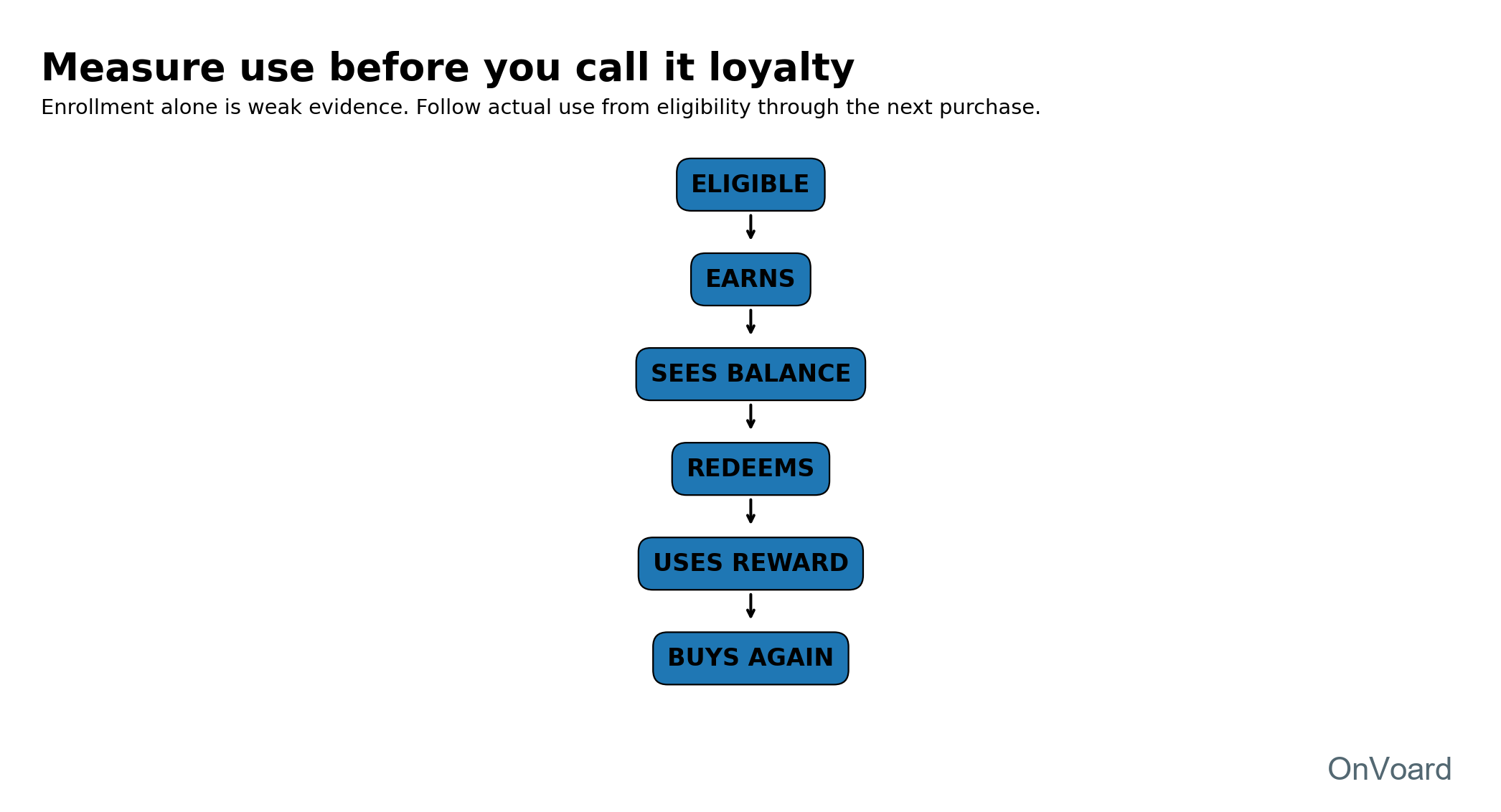
Membership count is usually the weakest first metric.
If account creation automatically enrolls customers, you can grow "members" without changing one purchase decision. A better measurement sequence follows actual use:
eligible customer -> earns -> sees balance -> redeems -> uses reward on an order -> buys again
That sequence separates reach from action.
We would watch at least these 5 numbers:
earning activation: what share of eligible customers actually earn;
redemption rate: what share of customers with enough value choose to redeem;
reward utilization: what share of issued rewards are actually used on an order;
repeat purchase after redemption: whether redeemers come back again after the reward order;
reward cost per redeemed order: what the program actually gives up when it gets used.
Then segment them. A program can look healthy in aggregate because a small group of heavy buyers already loves the brand.
This is also where we need to be careful with causality. If members spend more than non-members, that does not prove the program caused the difference. Loyal customers are more likely to join or use loyalty programs in the first place.
To test what the program adds, define the eligible unit as a customer account before launch and randomly assign each eligible account to treatment or holdout. Keep that assignment fixed across account, email and onsite surfaces so a holdout cannot receive the program by another route. Run the test through at least 1 normal repeat-purchase cycle for the store. Before launch, choose a primary outcome such as repeat purchase after reward eligibility, and guardrails such as reward cost per redeemed order, contribution after reward cost and support contacts. Continue only when treatment improves the primary outcome without breaking a guardrail. Otherwise stop or revise the program. If a holdout is not possible, compare pre-launch and post-launch cohorts matched on order history and label that result directional.
The failure modes we would check first
A loyalty program usually fails in boring ways, not because it lacks another gamified feature.
The first reward takes too long. Customers understand the promise but never reach a useful threshold. Fix the earn rate or first reward before adding a second currency.
The point value is opaque. If the account says "1,842 points" and the customer still cannot tell what that buys, the balance is not motivating anything. Show the nearest reward and the value gap.
The next tier changes almost nothing. A new label, icon and birthday email do not justify a status ladder. Give the next tier faster earning, access, service or another frequent benefit.
Paid membership needs a spreadsheet to justify. If the merchant cannot explain the fee with 1 or 2 concrete benefits, the customer will not do the math either.
Too many actions earn points. Social follows, profile fields, app installs, reviews, referrals, birthdays, quizzes and clicks can turn the program into a task farm. Reward actions because they matter, not because they are trackable.
Expiration becomes a surprise. Expiration can create urgency, but invisible expiration creates support tickets and distrust. Show the date and remind before value disappears.
The reward cost ignores margin. A flat percentage reward may be fine on one category and painful on another. Model the expensive basket, not only the average basket.
The program is isolated from the rest of the customer journey. A balance hidden in an account page is not a retention system. Customers need to see earned value at the moments where it changes a decision.